


Why choose high-quality LEDs for a home project?
Home lighting is no longer just about dispelling darkness; it's an essential part of interior architecture and living comfort. When it comes to demanding home projects, such as new construction or extensive renovations, the difference between cheap bulk products and professional-grade components quickly becomes apparent. A high-quality LED strip offers several advantages that basic solutions cannot achieve.
The first and most important factor is light quality. High-quality components use carefully selected diodes, which ensure a consistent color temperature across the entire strip. This means that the light won't appear green at one end of the strip and yellow at the other. Furthermore, the color rendering index (CRI) in top-tier products is invariably over 90. This ensures that home materials, textiles, and surfaces look natural and vibrant – exactly as the designer intended them to be.
Another significant reason is durability. In demanding projects, light fixtures are often installed into structures, such as ceiling coves or inside furniture, making their replacement cumbersome. Professional-grade products are designed to last tens of thousands of hours without significant light output degradation. To learn more about this topic and explore options, you can read more here: LED strip.
Technical specifications and long lifespan
When assessing the quality of LED products, technical specifications tell a lot more than just the price. Modern COB (Chip on Board) technology has revolutionized the way an LED strip produces light. Unlike traditional SMD strips, where LED dots are clearly separate, a COB strip produces a completely even and continuous line of light without any dotting. This is critical, especially when the strip is installed in a shallow profile or near reflective surfaces.
- Voltage (V): In professional use, 24V is standard. It allows for longer runs without voltage drop, meaning the light is equally bright at the beginning and end of the strip.
- Power (W/m): For kitchen backsplashes, a power of 12W/m – 15W/m is generally recommended, while for ambient lighting alone, 5W/m – 9.6W/m is sufficient.
- Color Rendering (CRI): Always choose CRI >90 for accurate color reproduction.
- Lumen (lm/m): Don't just focus on watts; check the luminous flux. For example, a 15W/m COB strip can produce up to 1400 lumens per meter.
A long lifespan is ensured not only by quality components but also by proper thermal management. Aluminum profiles are not just an aesthetic choice; they act as heat sinks that dissipate heat away from the LEDs. This prevents premature dimming and burning out of the diodes. If you need help interpreting technical data, our LED strip guide provides more in-depth information on choosing the right product.
Lighting solutions for different rooms in the home
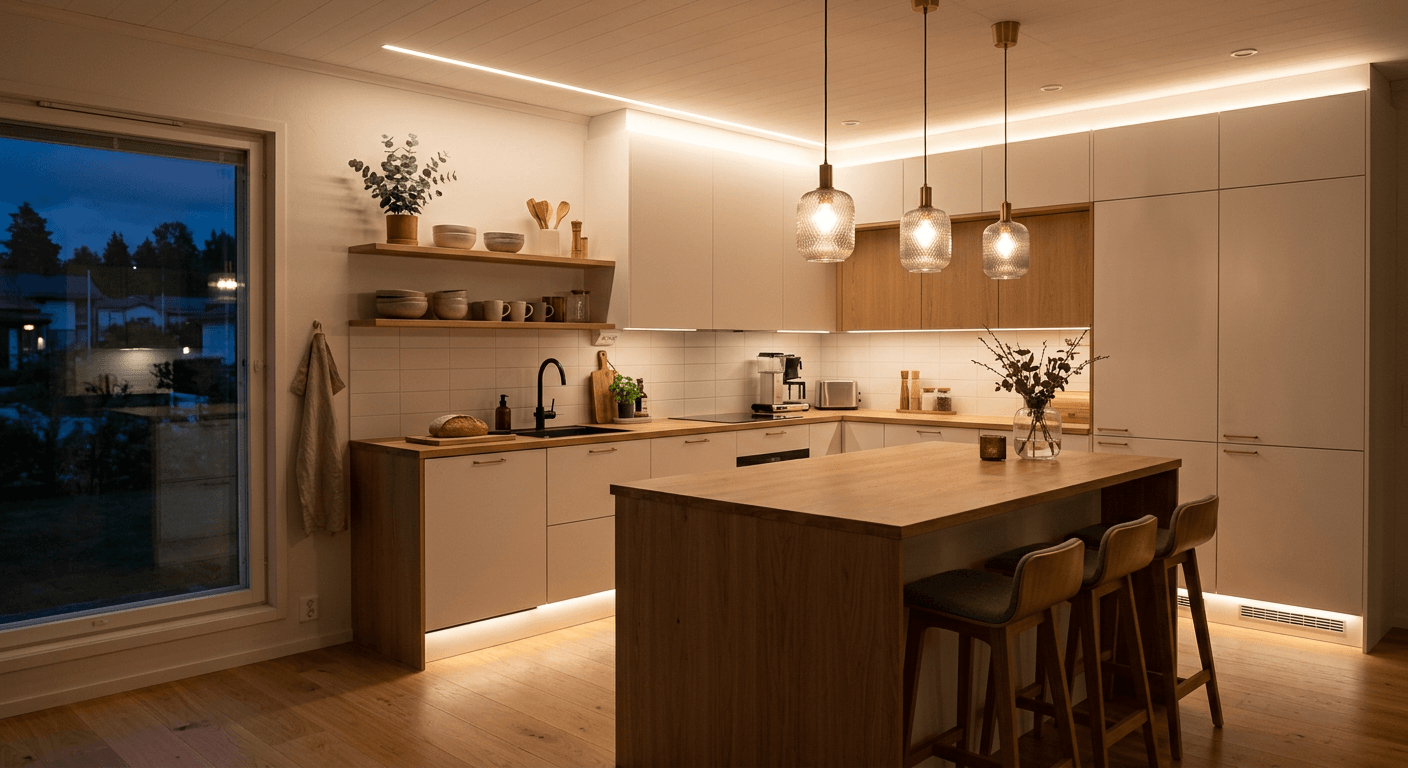
Each room has its own lighting requirements. The kitchen is one of the most demanding spaces, as it requires both effective task lighting and stylish ambient lighting. In the kitchen backsplash, the LED strip is usually installed in an aluminum profile under the upper cabinets. In this case, the light must be strong enough to make cooking safe and comfortable.
In the living room and bedroom, indirect lighting is emphasized. A light strip installed behind curtain rods or at the ceiling line adds depth and softness to the space. Indirect light reflects off the ceiling or wall, preventing glare and creating a calm atmosphere. For this use, CCT-adjustable strips (Tunable White) are excellent, as you can adjust the light tone from daylight (5000K) to the warm glow of dusk (2700K).
Walk-in closets and shelving units benefit from compact profiles and low-power strips. Automatic illumination when the door opens adds a touch of luxury to everyday life. In all these cases, a correctly dimensioned LED strip is a crucial factor in creating a successful ambiance.
Durability and safety in demanding conditions
Wet areas and saunas place extreme demands on lighting. In a sauna, temperatures can rise up to one hundred degrees, which would destroy a regular LED strip in no time. Therefore, sauna lighting must use specially designed, heat-resistant, and IP65 or IP67 rated products. These strips are protected with silicone that withstands heat and moisture without cracking.
In bathrooms, safety is paramount. The IP rating indicates the luminaire's protection against water and dust. For example, a higher IP rating is required in the immediate vicinity of a shower than in dry areas. It is also important to remember that transformers and control units must be placed in a dry area or installed in appropriate watertight enclosures. Professional design ensures that the lighting is not only beautiful but also compliant with electrical safety regulations.
Smart control and dimming possibilities
No demanding lighting project is complete without smart control. Today, consumers expect flexibility and ease of use from their lighting. Zigbee, Matter, and Casambi are among the most popular wireless standards that allow an LED strip to be integrated into a smart home. This enables controlling lights with a phone, voice, or wireless switches without complex wiring.
Dimming is key to creating atmosphere. High-quality transformers and controllers allow for smooth dimming down to 0.1% without flickering. This is especially important in rooms where time is spent in the evenings, such as the living room or home theater. When choosing components, ensure their compatibility; for example, TRIAC dimming suits traditional wall dimmers, while wireless solutions offer more adjustment options, such as timers and pre-set lighting scenes.
Expert tips for successful implementation
Successful lighting requires careful advance planning. Here are our experts' most important tips to help you avoid common pitfalls:
- Measure and plan: Calculate the required length in meters and ensure that the transformer has sufficient power reserve (about 10-20%).
- Use profiles: An aluminum profile protects the strip from mechanical stress and improves cooling, extending its lifespan.
- Consider voltage drop: If installing tens of meters of strip, feed power from multiple points or use a higher voltage (24V).
- Choose the right color temperature: Consider the purpose of the space. 3000K is warm and inviting, 4000K is neutral and fresh.
- Test before final installation: Connect the LED strip to the transformer and ensure everything works and the shade is as desired before adhering it to the profile.
High-quality lighting is an investment that improves quality of life and increases property value. To ensure your project succeeds on the first attempt, explore our comprehensive selection and utilize the content of our LED strip selection guide.
If you have any questions about product compatibility or need help planning your project, our experts are ready to assist. You can contact us directly: Contact us here.


0 comments