


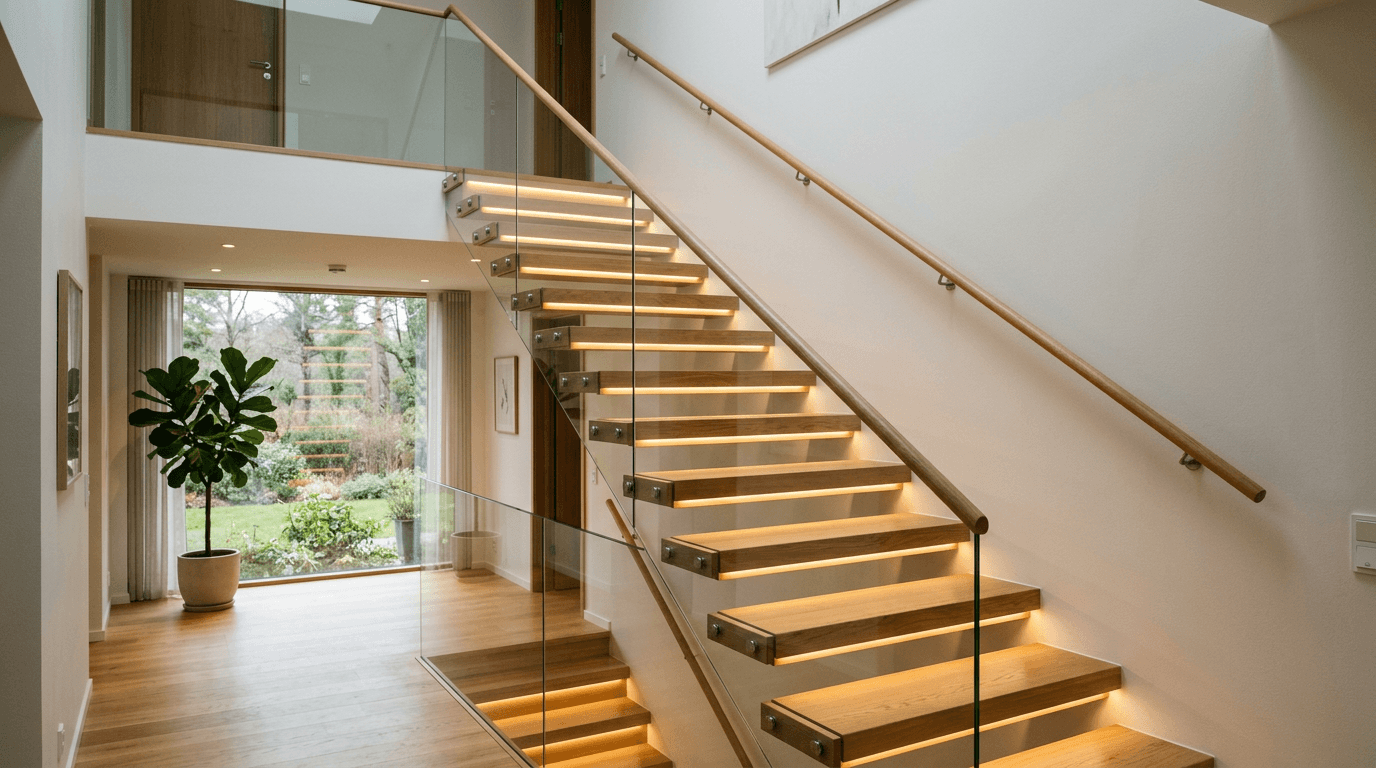
Stair lighting is one of those solutions that combine practicality and ambiance. A well-executed LED strip helps to delineate the steps better, increases safety, and makes the staircase a finished-looking part of the interior design.

Why is stair lighting important?
In stairs, the most important function of lighting is not just to look good. Well-designed lighting helps to delineate step edges and height differences more clearly, which improves safety, especially in the evenings and in dim spaces.
Good stair lighting is particularly helpful in these situations:
• step edges are more visible
• movement is safer in the dark
• the staircase looks more finished
• the space gets a more impressive and modern look
Another important aspect of stair lighting is that the light should not be dazzling. The goal is not to make the stairs too bright, but to make the steps stand out softly and clearly.
Where should LED lighting be installed?
LED stair lighting can be implemented in several ways. In practice, the most popular options are:
• on the front edge of the step
• under the step as indirect light
• on the wall next to the stairs
• integrated into the handrail
• on the side of the staircase embedded in a profile
If the goal is to emphasize the shape of the steps, the light should be directed so that the edge of the step is clearly visible. If a softer ambiance is desired, indirect light under the step or on the wall surface often works better.
Valotehdas's previous article also discusses LED profiles for stairs, which can be used to highlight step edges and provide a neat finish.

What kind of LED strip is suitable for stairs?
When choosing an LED strip for stairs, at least these factors should be considered:
• sufficient light output without glare
• even light distribution
• suitable color temperature
• use of a profile for a neat result
• dimming or motion sensor, if needed
Stairs generally do not require as strong a light as, for example, a kitchen countertop. Often, a slightly softer and more even light works better, as the most important thing in a staircase is to perceive the steps without glare.
For color temperature, a good choice is often:
• 3000 K, if a warm and atmospheric look is desired
• 4000 K, if a more neutral and slightly more technical impression is desired
Why is a profile almost always a good solution for stairs?
An LED strip on stairs should generally be installed in an LED profile. The profile makes the implementation neater, protects the strip, and helps to direct the light in the right direction.
The advantages of a profile in stairs are:
• the light line looks finished
• the strip is better protected from impacts and dust
• the diffuser softens the light
• the installation looks more professional
A suitable solution for the edge of a stair step could be, for example, the PORRAS10 DOWN LED profile for stair lighting, which is specifically designed for stair lighting.
If the stairs are tiled, a good option could be the PORRAS10 TILE LED profile for tiled stairs, which is designed for finishing and lighting the edges of tiled stairs.
A motion sensor makes stairs more practical
Stair lighting often works best when it doesn't always need to be manually controlled. With a motion sensor or automatic control, the light only turns on when there is movement in the staircase.
This is especially useful:
• at night
• in stairs leading to the hallway or basement
• in families with children
• in places where the staircase is used frequently
Stair lighting can be made more practical by adding a PIR motion sensor, so the lights turn on automatically when moving in the stairs.
If you are looking for broader solutions for automation and control, you can also explore Valotehdas's lighting control products.

Indoor stairs or outdoor stairs?
For indoor stairs, the most important thing is usually the perception of steps and glare control. For outdoor stairs, weather conditions such as moisture, dirt, and temperature fluctuations must also be taken into account.
If the lighting is for outdoor stairs, the following must also be considered:
• the luminaire's IP rating
• frost resistance
• weather resistance of installation materials
• adequate mechanical protection
In indoor stairs, the visual quality of the lighting is more emphasized, while in outdoor stairs, technical durability is key.
Summary
LED stair lighting is a good solution when you want to increase both safety and visual appeal. A good result is achieved when the steps are clearly visible, the light is not dazzling, and the lighting is adapted to the structure of the staircase.
The most important things in stair lighting are:
• clear perception of step edges
• avoiding glare
• suitable soft and even light
• use of a profile for a neat result
• motion sensor or dimming, if needed
When these factors are taken into account, stair lighting functions well both practically and as part of the interior design.
Looking for solutions for stair lighting?
Explore Valotehdas's LED strips, profiles, and control solutions, and build safe and stylish lighting for your staircase.
Explore LED profiles


0 comments