


Why choose flicker-free LED lighting?
Lighting quality is more than just the amount of light. When it comes to dimmable LEDs, the technical implementation becomes central. Many cheaper LED solutions use PWM (Pulse Width Modulation) technology, which can cause imperceptible flickering that the brain still detects. High-quality, flicker-free lighting, on the other hand, guarantees a steady light output at all brightness levels, making the environment pleasant.
Flicker-freeness indicates that the power supply and control electronics are of high quality. When you choose professional-grade components, such as efficient 24V power supplies, you avoid flicker-related problems, which often become more pronounced precisely when the light is dimmed to its lowest levels. This is especially important in spaces where a lot of time is spent, such as the kitchen or living room.
High-quality dimmable LEDs not only eliminate flickering but also offer smooth transitions between light levels. When the light dims linearly and without jumps, the eye can adapt to the change naturally. This creates a luxurious and thoughtful impression for home lighting, whether it's subtle mood lighting or powerful task lighting.
The impact of flicker-free light on well-being and concentration
Light directly affects our alertness and health. Poor quality, flickering light can cause headaches, eye strain, and general restlessness, even if we don't consciously notice the light fluctuations. Especially in workstations and kitchens, where precision is needed, steady and dimmable LEDs are an essential part of ergonomics.
A high color rendering index (CRI>90) combined with flicker-free light ensures that the environment looks natural. Wood surfaces, textiles, and food items are reproduced authentically, which increases the comfort of the space. When light can be adjusted as needed without compromising quality, an environment is created that supports both concentration-demanding work and recovery. Explore different ways to control light and its impact on our LED lighting control page.
In the evening, the quality of light becomes even more important. When brightness is reduced to support the production of sleep hormones, it is critical that the light spectrum or stability does not become unpleasant. Flicker-free dimming allows for low light levels without technical disturbances, which helps the body to calm down for sleep. This is a significant factor in modern homes, where lighting is intended to support the natural daily rhythm.
Benefits of dimming for creating a home atmosphere
Lighting is one of the most effective ways to change the mood of a space in seconds. Dimmable LEDs enable versatile use of the same space: the kitchen transforms from a bright baking area to a dim and atmospheric dinner setting with just an adjustment. Indirect lighting, implemented with LED strips and aluminum profiles, such as SEINÄ12 or VIIVA8, creates depth and softness in the space.
For ambient lighting, it is important that the light can be adjusted to the exact desired level. COB-LED strips are excellent in this respect, as they produce completely dot-free and uniform light even without a deep profile. When such a strip is dimmable, a seamless light strip is achieved that emphasizes the architecture without glare. Light adjustment is easy and effective with the right lighting control systems, which allow for precise control.
Dimming is not just about adjusting brightness; it's also about controlling shadows and highlights. You can dim the general lighting and leave certain interior elements, such as paintings or plants, slightly brighter. This creates dynamism and makes the home more interesting. Dimmable LED technology gives you the tools to be your own home lighting designer.
How to choose the right dimmer for LED lamps
Choosing the right dimmer is a critical step to achieve a flicker-free result. Traditional dimmers designed for incandescent lamps rarely work reliably with LED products. It is important to check whether it is a leading-edge or trailing-edge dimming, and to choose the power supply accordingly. Nowadays, smart control solutions that integrate dimming as part of a smart home are often recommended.
Zigbee, Matter, and Casambi controls are the most popular choices for modern homes. These systems allow for very precise and wide dimming ranges, often from 0.1% to 100%. Since the control is digital, the flickering or "humming" caused by traditional dimmers is eliminated. Modern control methods can be found consolidated here.
When choosing a dimmer, also consider the load. The total power (W) of LED strips and lamps should not exceed the capacity of the dimmer or power supply, but it also should not be too small in relation to the minimum load if a traditional wall dimmer is used. Professional-grade 24V systems are more reliable in this regard, as they are designed to operate stably over a wide power range.
Tips for lighting different rooms with dimmable LED lights
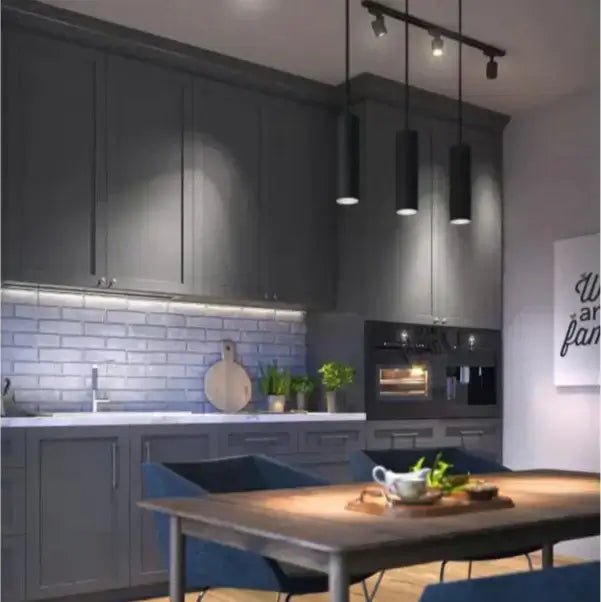
Different rooms place different demands on lighting. In the kitchen, strong light is needed for work surfaces, but in the evening, soft general lighting is more pleasant. By using, for example, a 15W/m COB-LED strip under kitchen cabinets and combining it with dimming, you get the best of both worlds. Cooking is safer in good light, and after cleaning, the light can be lowered to a calm background light.
In damp rooms, such as a sauna or bathroom, dimmable LED lighting creates a spa-like atmosphere. In a sauna, it is important to use IP65-rated strips that can withstand high temperatures. When the light is installed, for example, behind the backrest and dimmed low, a relaxing atmosphere is created where the mind can rest. In the bathroom, dimming, in turn, makes mornings easier, when bright light can feel too harsh.
In the living room and bedroom, it is worth utilizing multiple light sources. Indirect light at the ceiling line or on wall surfaces creates a sense of space. By using aluminum profiles, such as PINTA10.v2 or NELIÖ16, the installation becomes neat and professional. Dimmability at all these points ensures that you can adjust the lighting to match, for example, a movie night or reading.
Energy saving and durability in dimmable lighting
Dimmable LED is not only a comfort factor but also an ecological choice. When you dim the light, you directly consume less electrical energy. Although LED lamps are already very energy efficient, regular dimming extends the lifespan of both the LED strip and the power supply. The less the components operate at full power, the less waste heat they produce.
Durability is also emphasized in the choice of materials. High-quality aluminum profiles act as cooling elements for the LED strip. When this is combined with smart dimming that avoids overloading, a lighting solution is obtained that lasts for years without maintenance needs. This reduces waste and saves money in the long run, as lamps or strips do not need to be replaced constantly.
Modern control systems can also automatically adjust the light according to the amount of daylight. This "daylight harvesting" principle ensures that light is used only as much as necessary. This maximizes energy savings without the user having to constantly adjust switches. Dimmable technology is thus an essential part of sustainable and modern living.
Common mistakes in implementing dimmable LED lighting
One of the most common mistakes is combining incompatible devices. Many acquire a high-quality LED strip but save on the power supply or use an old wall dimmer. This often leads to the very flickering that one wants to get rid of. It must always be ensured that the entire chain – dimmer, power supply, and LED – speaks the same language and supports the same dimming technology.
Another mistake is neglecting color rendering and color temperature. If a dimmable LED has poor color rendering (CRI < 80), the light often becomes grayish and lifeless when dimmed. The choice of color temperature is also important; warm 3000K light often works better at home for creating an atmosphere than cold 4000K, although CCT-adjustable strips offer the best flexibility here.
Finally, compromising on installation quality can ruin even a good plan. An LED strip installed without an aluminum profile can overheat, which shortens its lifespan and may cause dimming instability. By using the correct accessories and carefully designing the control system, a result is achieved that delights day after day. If you need help with design or technical questions, you can always contact us: contact information.


0 comments