


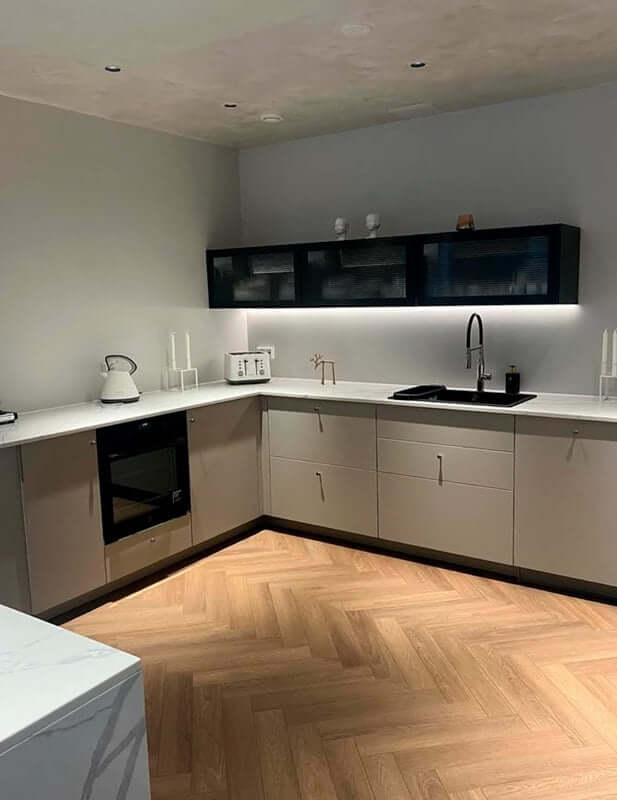
In brief: A COB LED strip uses Chip-on-Board technology that places over 500 microscopic LED chips per metre under a continuous phosphor coating, producing completely even, dotless light. Unlike traditional SMD strips with visible individual diodes, COB strips eliminate reflections on glossy surfaces, offer 180° beam angles, typically deliver CRI>90 colour rendering, and create a professional finish in shallow aluminium profiles. They're ideal for modern kitchens, bathrooms, indirect lighting and any application where seamless light quality matters.
What is COB LED strip technology?
COB stands for Chip-on-Board, a lighting technology that represents a significant evolution from traditional LED strip designs. Instead of mounting individual LED diodes at intervals along the circuit board, COB technology positions hundreds of microscopic LED chips directly onto the board in extremely high density. The entire surface is then covered with a continuous phosphor layer that transforms the light from the chips into a soft, uniform glow.
In practical terms, one metre of COB LED strip contains over 500 tiny LED chips. When these chips illuminate beneath the continuous coating, the human eye cannot distinguish individual light sources – you see only a seamless ribbon of light. This eliminates the "dotting" effect that has plagued traditional LED strips, where individual diodes create visible points of light that reflect as dots on glossy surfaces like kitchen worktops, tiles or mirrors.
Quality COB LED strip also delivers superior energy efficiency and longevity. The dense chip positioning and direct contact with the circuit board improve heat management when the strip is properly installed in an aluminium LED profile. This ensures that light output remains bright for years and the colour tone stays pure without yellowing or degradation.
COB vs SMD LED strip: detailed comparison
The most visible difference between COB and SMD (Surface Mounted Device) strips is light uniformity, but the technologies differ in several important ways that affect installation, performance and aesthetics:
| Feature | COB LED strip | Traditional SMD LED strip |
|---|---|---|
| Dot visibility | Completely seamless; over 500 chips/m create continuous light | Individual LED dots visible, typically 60–120 diodes/m |
| Beam angle | Up to 180° thanks to continuous surface | Typically 120°, more directional |
| CRI (colour rendering) | CRI>90 standard, excellent colour accuracy | Varies widely; budget strips often CRI<80 |
| Profile depth required | Works in very shallow profiles (8–10mm) without dots showing | Needs deeper profiles or thick diffusers to hide dots |
| Flexibility | More fragile; phosphor coating can crack if bent sharply | More robust; individual diodes less sensitive to bending |
| Price level | Higher initial cost due to advanced manufacturing | Lower cost, widely available in various qualities |
| Typical uses | High-end kitchens, visible installations, indirect lighting, architectural features | General lighting, hidden installations, budget projects, outdoor lighting |
If an SMD strip is installed above a glossy kitchen backsplash or polished marble worktop, the result is often a distracting row of reflected light dots. COB technology completely eliminates this problem, creating an even reflection on any surface. This makes white COB strips particularly popular for kitchen task lighting where both brightness and visual comfort matter.
The wider beam angle of COB strips means they work exceptionally well in shallow aluminium profiles such as MINI10 or VIIVA8 models, where the distance from LED to diffuser cover is very small. Traditional SMD strips in such shallow profiles often show visible hotspots even through frosted diffusers.
What about CSP technology?
CSP (Chip Scale Package) is another dotless LED technology closely related to COB. Like COB, CSP strips produce seamless light, but the manufacturing process differs slightly. CSP chips have their phosphor coating applied individually before being mounted extremely close together on the circuit board, whilst COB applies a single continuous coating over all chips at once.
For end users, CSP and COB perform similarly – both deliver dotless, even light with high CRI and wide beam angles. Light Factory groups these technologies together in the COB LED strips collection because they solve the same problem and suit the same applications. The choice between them typically comes down to specific product availability and minor differences in flexibility or power density.
How to choose the right COB LED strip
Voltage: 12V, 24V or 48V?
Most quality COB strips operate at 24V, which offers the best balance of efficiency, cable length capability and light uniformity. The 24V system allows longer runs (typically 5–10 metres) from a single power connection point without noticeable voltage drop or dimming at the end of the strip.
Some manufacturers also offer 12V COB strips, which can be useful for very short runs or when matching existing 12V systems. However, 12V strips are limited to shorter lengths before voltage drop becomes visible. Increasingly, high-power installations use 48V systems, which enable even longer runs and thinner cables, though these require compatible LED drivers and are less common in residential settings.
When planning your installation, choose the voltage that matches your run lengths and makes power supply placement practical. For most home projects, 24V COB strips paired with a correctly sized 24V driver offer the most flexibility.
Power per metre: how much do you need?
COB LED strips are available in various power densities, typically ranging from 5W/m for subtle mood lighting up to 15W/m or higher for bright task lighting. Here's how to choose:
- 5–7W/m: Ideal for ambient and mood lighting in living rooms, bedrooms, behind shelves or in decorative applications. Produces soft, comfortable light without overwhelming brightness.
- 9.6–10W/m: A versatile middle ground suitable for general indirect lighting, wardrobes, display cabinets and moderate task lighting needs.
- 12–15W/m: High-output strips for kitchen worktop lighting, bathrooms, workshops or anywhere you need strong, functional task lighting. A 15W/m strip typically delivers around 1400 lm/m – comparable to traditional under-cabinet fluorescent fixtures but with better colour rendering and no flicker.
Remember that higher power strips produce more heat and absolutely require installation in aluminium profiles for proper heat dissipation. The profile acts as a heat sink that extends strip lifespan and maintains consistent light output. Never install high-power COB strip directly on wooden surfaces or other materials that don't conduct heat effectively.
Colour temperature and tunable white options
COB LED strips are available in fixed colour temperatures and tunable white (CCT) versions:
Fixed white temperatures: White COB strips come in standard temperatures from warm 2700K (resembling incandescent bulbs) through neutral 4000K to cool 6500K (daylight white). For most homes, 3000K offers a pleasant warm white suitable for living spaces, whilst 4000K works well in kitchens and bathrooms where colour accuracy matters for tasks like food preparation or applying makeup.
Tunable white (CCT): Tunable white COB strips contain two channels of LEDs (typically 2700K and 6500K) that can be mixed to produce any colour temperature in between. This enables you to adjust lighting according to time of day or activity – warmer tones for evening relaxation, cooler tones for morning alertness. These strips require a compatible controller and slightly more complex wiring but offer maximum flexibility.
Coloured options: Coloured COB strips in red, green, blue or RGB combinations are also available for decorative and accent lighting applications, though these are less common than white versions.
Installation considerations for COB strips
Whilst COB LED strip installation follows similar principles to traditional strips, a few factors require special attention:
Handle with care: COB strips are more mechanically sensitive than SMD strips. The continuous phosphor coating can crack if you bend the strip too sharply or press hard on its surface. Always use corner pieces or flexible COB connectors at corners during installation. Never fold or crease the strip.
Always use aluminium profiles: Even moderate-power COB strips benefit enormously from aluminium profiles. Profiles such as SUORA12, PINTA14 or SEINÄ12 don't just make installations look professional – they act as essential heat sinks that extend strip lifespan by years. The improved thermal management keeps LED chips cooler, maintaining brightness and preventing premature colour shift.
Correct power supply sizing: COB strips require a 24V LED driver whose output capacity (watts) exceeds the total strip power by at least 10–20%. For example, if you're installing 3 metres of 10W/m strip (30W total), choose a driver rated for at least 33–36W. This headroom prevents the power supply from running at maximum capacity, which generates excess heat and shortens its life. See our driver sizing guide for detailed calculations.
IP rating for wet areas: Most COB strips are IP20-rated for dry indoor use. If you need lighting in bathrooms, saunas or other moisture-prone areas, choose waterproof COB strips with IP65 or IP67 protection. These have silicone coatings that protect the electronics from moisture, though they're slightly less flexible and require special waterproof connectors.
Where COB LED strips excel
Kitchen worktop lighting: COB strips have revolutionised kitchen lighting. Installed in profiles under wall cabinets, they provide abundant, shadow-free task lighting without the dot reflections that plagued glossy backsplashes. The high CRI>90 ensures food colours look natural and appetising.
Bathroom and mirror lighting: The even, flattering light from COB strips makes them ideal for bathroom mirrors and vanity lighting. No harsh shadows or dots distract from grooming tasks, and the seamless appearance complements modern bathroom design.
Indirect architectural lighting: COB strips create beautiful soft washes of light when installed in profiles along ceiling perimeters, behind floating shelves or in wall recesses. Because the light source itself is smooth and continuous, the reflected light on walls and ceilings is equally clean and professional-looking.
Visible decorative installations: Unlike traditional LED strips that look technical when exposed, COB strips are attractive enough to leave visible. They work beautifully in glass shelves, transparent furniture or modern fixtures where the strip itself becomes a design element.
Hospitality and retail: Hotels, restaurants and shops increasingly specify COB strips because the quality of light directly affects customer experience. Even lighting showcases products accurately, creates comfortable atmospheres and conveys attention to detail.
Smart control and dimming
COB LED strips integrate seamlessly with modern lighting control systems. Basic installations use simple wall-mounted dimmers, whilst more advanced setups connect to smart home platforms like Zigbee, Matter or Casambi. These systems enable:
- Smartphone and voice control of brightness and (for CCT strips) colour temperature
- Scheduling and automation based on time of day or occupancy sensors
- Scene creation – preset lighting moods recalled at the touch of a button
- Integration with other smart devices for whole-home automation
When selecting controllers and dimmers, ensure they're rated for the total wattage of your installation and compatible with 24V LED strips. Most quality controllers handle both single-colour and tunable white COB strips, though RGB versions require specific RGB/RGBW controllers.
Why dotless LED strips suit modern homes
A modern home demands more from lighting than simple illumination – it requires quality, atmosphere and durability. Dotless COB LED strip technology meets all these requirements. The visual superiority over older LED technology is immediately apparent, offering the kind of finish previously seen only in high-end commercial projects or luxury properties.
The even line of light creates visual calm and provides opportunities to play with shadows and highlights in new ways. High colour rendering ensures that your home's interior shines in all its true hues, making spaces more vibrant and inviting. Materials like wood grain, textiles and artwork appear exactly as they should, without the colour distortion common in budget lighting.
Ultimately, it's about the complete package: when you combine quality COB strip from our COB LED strips collection, correctly chosen aluminium profiles and intelligent control, you create lighting that improves quality of life daily. Whether it's bright kitchen task lighting or subtle mood lighting in a bedroom, COB technology guarantees a seamless result that stands the test of time.
For expert help choosing the right lighting solution for your specific project or technical questions about COB installation, contact us at asiakaspalvelu@valotehdas.fi or visit our Nummela showroom (phone 010 311 2830). Our lighting specialists can help you specify the perfect combination of strips, profiles, drivers and controls for your needs.
Frequently asked questions
Can I cut COB LED strips to length like traditional strips?
Yes, COB LED strips have designated cutting points marked along their length, typically every 25mm, 50mm or 100mm depending on the model and voltage. Always cut only at these marked points to avoid damaging the circuit. However, be more careful when handling cut COB strips than SMD strips – the exposed end of the phosphor coating is vulnerable, so seal it properly with end caps or heat-shrink tubing if the end will be visible or exposed to moisture.
Do COB LED strips work with standard LED dimmers?
COB strips are compatible with most quality LED dimmers designed for low-voltage (24V) LED strips. However, ensure your dimmer is rated for the total wattage of your installation and uses PWM (Pulse Width Modulation) or similar flicker-free dimming technology. Cheap phase-cut dimmers designed for mains-voltage lighting often cause flickering or limited dimming range with LED strips. For best results, use dimmers specifically marketed for LED strip lighting.
How long do COB LED strips last compared to SMD strips?
Quality COB LED strips typically last 30,000–50,000 hours when properly installed with adequate heat management, comparable to good SMD strips. The key to longevity is installation in aluminium profiles that dissipate heat effectively. Without proper cooling, both COB and SMD strips will degrade faster, losing brightness and shifting colour temperature over time. The dense chip arrangement in COB strips actually helps with heat distribution across the strip surface, but the heat must still be conducted away through a profile.
What's the minimum bending radius for COB LED strips?
COB strips are less flexible than traditional SMD strips due to the continuous phosphor coating. Most manufacturers specify a minimum bending radius of 50–100mm depending on strip width. Never bend COB strips at sharp right angles – instead, use corner connectors or flexible wire links at corners. If your installation requires following tight curves, consider whether a flexible SMD strip might be more appropriate, or plan your layout to avoid sharp bends.
Can I install COB LED strips outdoors?
Standard IP20 COB strips are designed for dry indoor use only. For outdoor installations or moisture-prone areas like bathrooms and saunas, choose waterproof COB strips with at least IP65 rating (protected against water jets) or IP67 (protected against temporary immersion). Even with waterproof strips, install them in locations protected from direct rain and ensure all connections use waterproof connectors. UV exposure can eventually degrade the silicone coating on waterproof strips, so avoid locations with intense direct sunlight unless the strips are specifically UV-stabilised.
Why are COB LED strips more expensive than traditional strips?
COB strips cost more because the manufacturing process is more complex and precise. Positioning hundreds of microscopic chips per metre with perfect density, applying the continuous phosphor coating evenly, and achieving consistent colour temperature across the entire strip requires advanced equipment and quality control. Additionally, COB strips typically use higher-grade LED chips with CRI>90, whilst budget SMD strips often use lower-CRI chips. The price difference reflects genuine technical advancement and superior light quality, not just marketing.
Do I need special connectors for COB LED strips?
Whilst some standard LED strip connectors physically fit COB strips, it's better to use connectors specifically designed for COB strips. These have contact designs that work reliably with the COB strip's circuit layout and often include features that protect the delicate phosphor coating at connection points. For corner connections, always use flexible wire links or special corner connectors rather than trying to bend the strip itself, which risks cracking the coating and damaging the chips underneath.


0 comments