


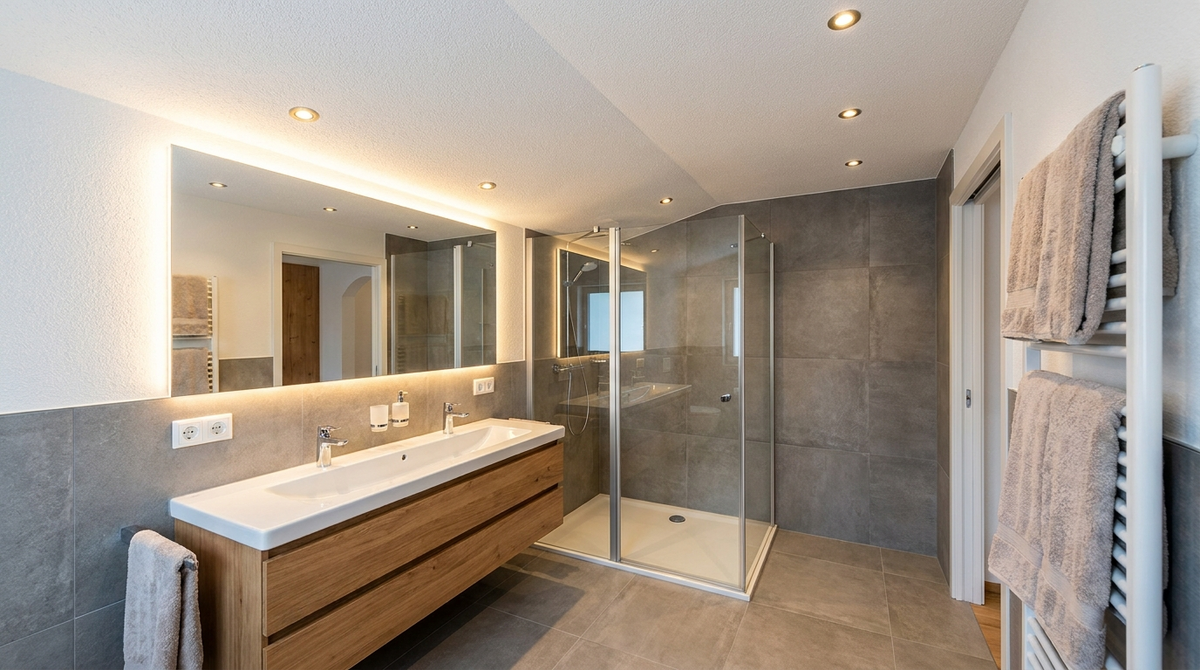
In brief: Bathroom luminaires are selected according to moisture zones. Inside the shower or bath (zone 0) requires minimum IP67 and safe low voltage, whilst above the shower and within approximately 0.6 m radius (zones 1–2) requires minimum IP44. For above the shower we recommend IP65. A good combination is IP44 downlights in the ceiling, IP65 LED strip behind the mirror or at the ceiling edge, and the power supply in a dry location. Installation must always be carried out by a qualified electrician.
The bathroom is the most demanding space in the home from an electrical safety perspective, as water and electricity constantly meet there. UK electrical safety regulations divide the bathroom into moisture zones which determine what types of luminaires may be installed in each location. This guide explains the zones and IP requirements clearly.
Bathroom Moisture Zones
The regulations are based on guidance from the Finnish Safety and Chemicals Agency (Tukes) on electrical installations in bathrooms and shower rooms.
- Zone 0: directly inside the bath or shower. Requires a luminaire rated minimum IP67, and the device must operate at safe low voltage.
- Zone 1: above the bath or shower, up to 2.25 metres in height. Requires minimum IP44 rating.
- Zone 2: approximately 0.6 metre radius from the bath or shower. Also requires minimum IP44 rating.
- Area outside zones: no special requirements normally, but if the bathroom connects to a sauna steam room, this area also requires minimum drip-proof (IP21) rating up to 120 cm distance.
Practical Recommendations
In unclear situations it's always worth selecting a higher IP rating than the minimum requirement specifies – this provides a safety margin for, for example, water jets used during cleaning.
- Above shower or bath: IP65 provides additional safety beyond the minimum requirement (IP44)
- Around washbasin: minimum IP44
- Elsewhere on ceiling outside zones: ordinary indoor luminaire suffices, unless the space connects to a sauna
Mirror Lighting – The Most Common Mistake
The most common mistake in bathroom lighting is a single ceiling luminaire directly above the mirror. This creates shadows under the eyes, nose and chin, making the lighting useless for shaving or applying makeup. A better solution is to position light either side of the mirror at approximately eye level, or install an IP-rated LED strip behind the mirror frame to achieve even, shadow-free light.
LED Downlights for Bathrooms
Recessed LED downlights are the most popular solution for bathroom general lighting. Choose either recessed or surface-mounted IP44 models according to installation location, depending on ceiling construction.
Connection to Sauna
If your bathroom is combined with a sauna, requirements become even stricter – see the sauna lighting guide for supplementary reading.
Electrical installations in bathrooms always require qualified work – always use an authorised electrician for installation. See the complete bathroom luminaires range.
What Does IP Rating Mean?
IP rating indicates how well an electrical device is protected against dust and water. The first number describes protection against solid objects and dust, the second number water protection. In bathrooms the second number is most important: 4 means protection against splashing water, 5 against water jets and 7 against temporary immersion. If a product has no IP marking, it should not be used in wet areas.
LED Strip in Bathrooms
LED strip suits bathrooms for soft indirect light, for example behind mirrors, under mirror cabinets, in furniture or at ceiling edges. Choose moisture-protected IP65 strip, install it in an aluminium profile with protective cover and position the power supply in a dry location. The entire system, including connections, must be suitable for wet areas.
Ceiling Light, Mirror Light and Indirect Light Together
Effective bathroom lighting usually consists of three parts: ceiling light for general illumination, even light for the face at the mirror, and LED strip for ambient light. There's a separate guide on mirror lighting: bathroom mirror lighting with LED solutions.
Frequently Asked Questions
What type of LED lighting is recommended for saunas or bathrooms?
For bathrooms we recommend minimum IP44-protected LED downlights in the ceiling and IP65-protected LED strip near the shower, for example behind the mirror or at the ceiling edge. Saunas require LED strip specifically designed for sauna use that withstands heat, with warm 2700 K light. Read more in the sauna lighting guide.
What IP rating is required for bathroom luminaires?
In zone 0 minimum IP67, in zones 1 and 2 minimum IP44. Outside zones an ordinary indoor luminaire suffices, unless the space connects to a sauna.
Where should LED strip power supply be positioned in a bathroom?
In a dry location outside the zones, for example in a suspended ceiling or adjacent room, so it remains accessible for maintenance.
Luminaires and LED strips for wet areas can be found in the collections bathroom and sauna LED strips and LED downlights. Our customer service team will be happy to help with selection.


0 comments