


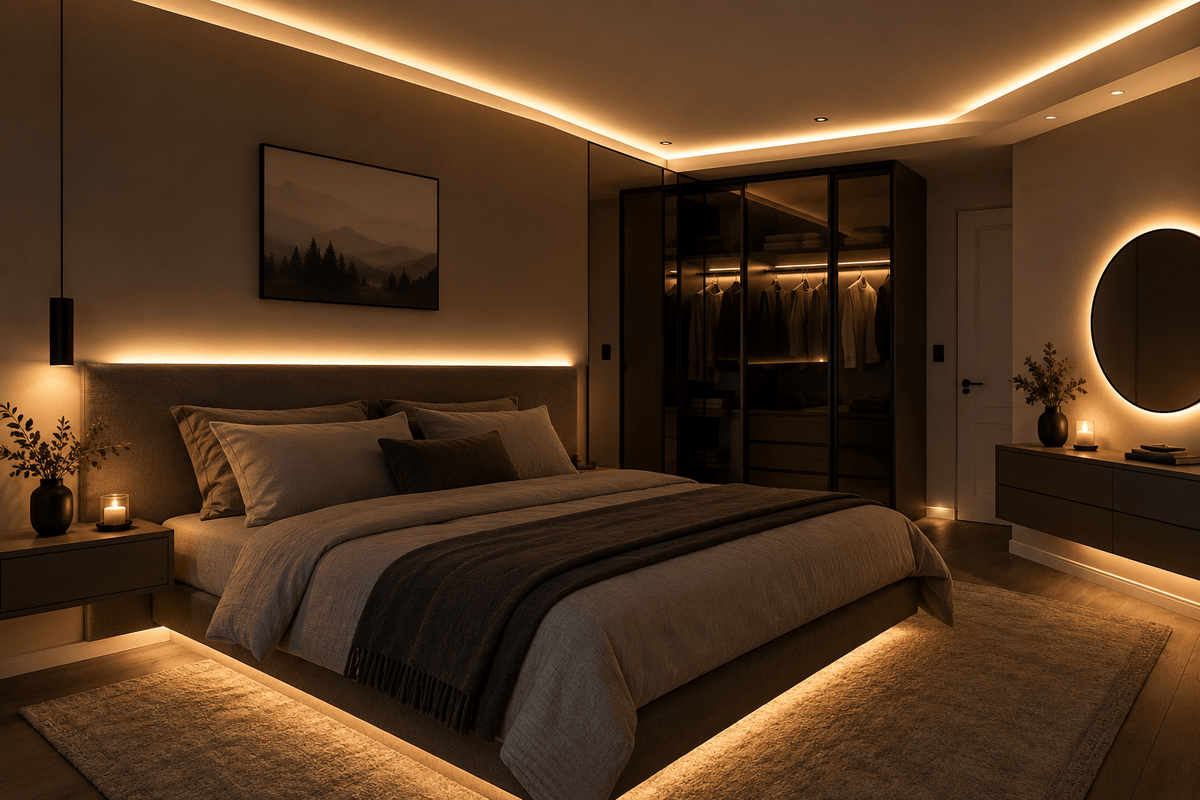
Creating a Peaceful Bedroom with LED Lighting
The bedroom is the space in your home where lighting should, above all, support relaxation. At the end of the day, bright and harsh light can feel intrusive, whilst soft, warm and properly directed light makes the space more peaceful.
Well-planned bedroom LED lighting doesn't mean just one ceiling fixture. Often the best result comes from multiple light sources: indirect lighting, dimmable LED strips, reading lights and, if needed, gentle mood lighting around wardrobes or the bed.
This guide explains how to choose the right LED strip for your bedroom, including colour temperature, dimming and profile options, so that the result is practical, calming and easily adjustable for everyday use.
Why Bedroom Lighting Matters
Bedroom lighting affects how the space feels and how it's used. In the morning, you might need clarity for dressing and tidying, but in the evening, that same bright general light can feel too intense. That's why it's worth planning bedroom lighting that can be adjusted according to the situation.
One common mistake is implementing bedroom lighting with just a ceiling fixture. It can illuminate the space effectively, but it's not always the best solution for atmosphere. When light comes straight down from above into your eyes, the mood can feel restless or too functional.
LED strips can bring soft indirect light into the bedroom – for example, behind the headboard, along the ceiling edge, in conjunction with curtain pelmets, inside wardrobes or underneath furniture. The light then reflects off walls, ceilings or other surfaces and feels considerably more pleasant than direct spotlights.
If you'd like more general inspiration for atmospheric lighting, have a look at Valotehdas's guide to mood lighting.
The Importance of Soft, Warm Light for Sleep and Relaxation
Light colour plays a major role in the bedroom. Light that's too cool and bright can make the space feel clinical and less calming. Warm light, on the other hand, supports a softer atmosphere and is particularly well-suited for evening use.
For most bedrooms, warm white light works best – for example, around 2700K or 3000K. 2700K often feels cosy and calming, whilst 3000K is slightly fresher but still warm. If you also apply makeup, get dressed or do detailed tasks in the bedroom, it can make sense to combine warm mood lighting with separate, brighter general lighting.
Don't choose colour temperature by numbers alone. Surface materials also affect the final result. Dark walls absorb light, pale surfaces reflect more of it, and wooden surfaces can make warm light feel even softer.
If kelvin values are still unfamiliar, Valotehdas's colour temperature guide helps you understand how 2700K, 3000K and 4000K differ in practice.
How to Choose the Right LED Strip for Your Bedroom
When choosing an LED strip, the most important consideration is its intended purpose. In bedrooms, LED strips are often used for mood lighting, where the goal isn't maximum light output but pleasant, even illumination.
If you're installing an LED strip behind the headboard or along the ceiling edge for indirect light, choose a warm white LED strip and combine it with dimming. This way, the light can be used at a calm level in the evenings and, when needed, slightly brighter.
If the LED strip will be visible or you want the light to be as uniform as possible, a COB LED strip can be a good choice. In COB strips, the individual light points don't stand out as they do in traditional LED strips, which creates a neater finish, especially in visible installations or shallow profiles.
When selecting an LED strip, consider at least these factors:
• Choose a warm white shade for the bedroom, such as 2700K or 3000K.
• Opt for a dimmable solution if the light will be used in the evenings.
• Use an LED profile if the strip is installed in a visible location or you want a neat finish.
• Consider light direction: indirect light is usually more pleasant in bedrooms than directly visible LED strips.
• Choose output according to purpose. Mood lighting often needs more modest power than task lighting.
The Benefits of Dimming and Indirect Lighting
Dimmable LED is an extremely useful solution in the bedroom. In the morning, you can use the light brighter; in the evening, you can dim it to a calm level. When you can adjust the lighting, the same LED solution serves multiple purposes.
With dimming, make sure the LED strip, power supply and controller are compatible. Not all LED solutions dim in the same way, and the wrong combination can cause flickering, uneven dimming or insufficient dimming range.
Valotehdas's guide to flicker-free dimmable LED lighting helps you understand what to consider before choosing products.
Indirect light is particularly well-suited to bedrooms because it doesn't shine directly into your eyes. When an LED strip is hidden – for example, behind trim, a profile, the headboard or furniture – the light reflects softly from surrounding surfaces. This makes the space calmer and reduces glare.
Good locations for indirect LED lighting in the bedroom include:
• Behind the headboard
• Along the ceiling-to-wall junction in a cove
• Inside curtain pelmets
• Underneath wardrobes or chests of drawers
• Backlighting for mirrors or dressing areas
Recommended Products: Warm LED Strips and Profiles
For bedroom LED lighting, choose products that support soft, adjustable illumination. In most cases, a good solution consists of a warm LED strip, suitable LED profile, power supply and dimmer.
Warm LED strips are particularly suited to mood lighting, behind headboards and for indirect installations. If you're aiming for the most uniform light line possible, consider COB LED strips as well.
Dimmable LED products make it easier to adjust lighting for different situations. In bedrooms, dimming is almost always a sensible choice, because the same light works differently in the morning, during the day and in the evening.
LED profiles finish the installation and protect the LED strip. A profile helps direct the light better, makes the installation look neat, and an opal diffuser can soften the light further.
If you're planning a more powerful LED strip solution elsewhere in your home, you can combine this topic with Valotehdas's earlier content on using high-output LED strips at home and in offices. In bedrooms, however, the emphasis is usually on softness, adjustability and avoiding glare.
Avoid Common Bedroom Lighting Mistakes
A little planning in bedroom lighting helps avoid many common problems. Often it's not that the products are wrong, but that the light has been poorly positioned or the overall scheme hasn't been thought through according to usage scenarios.
One of the most common mistakes is light that's too bright or too cool. In bedrooms, 4000K can feel too functional in many situations, especially if used as the main light in the evenings. It might work in a dressing room or for makeup lighting, but for mood lighting, a warm tone is usually better.
Another mistake is installing LED strips so that individual light points are directly visible. This can make the result feel restless and glaring. An LED profile, opal diffuser or indirect installation method usually solves the problem easily.
A third mistake is forgetting dimming. Without dimming, the light is either on or off, and you can't adapt it for evening use. A dimmable solution makes the lighting considerably more versatile.
A fourth mistake relates to choosing the power supply and controller. The LED strip's power output, length and voltage must match the power supply. If the combination is unclear, ask for help before ordering to ensure all components work together properly.
Frequently Asked Questions About Bedroom LED Lighting
What colour temperature works best in bedrooms?
For most bedrooms, warm white light such as 2700K or 3000K works well. 2700K is soft and cosy, whilst 3000K is slightly fresher but still a warm option.
Can LED strips be dimmed easily?
Yes, when the LED strip, power supply and dimmer are chosen to be compatible. It's worth planning dimming before ordering products, so the result works properly.
What's the benefit of indirect lighting in bedrooms?
Indirect lighting reduces glare and makes the light softer. It works well behind headboards, along ceiling edges, in curtain pelmets or in conjunction with furniture.
How do I install an LED profile in a bedroom?
LED profiles are usually fixed to walls, ceilings, furniture or trim structures. The LED strip is installed inside the profile, and an opal diffuser can be added on top to soften the light.
Can LED lighting affect sleep?
Light colour and intensity can influence how calming the space feels in the evenings. In bedrooms, it's advisable to favour warm, dimmable and indirect light, especially before bedtime.
Do I need an LED profile in the bedroom?
An LED profile is particularly recommended when the LED strip will be in a visible location or you want a neat, finished and durable installation. Profiles also help control light direction.
Buy the Best Products for Soft Bedroom Lighting
Calming bedroom LED lighting comes from the right combination: a warm LED strip, effective dimming, a suitable power supply and a neat LED profile. When these are chosen together, the result is pleasant, practical and long-lasting.
Browse Valotehdas's range and choose softly illuminating warm LED strips, easily adjustable dimmable LED products and installation-finishing LED profiles for your bedroom.
If you're unsure about the right LED strip, power supply or dimming method, Valotehdas can help you choose a complete solution suitable for your bedroom.


0 comments