


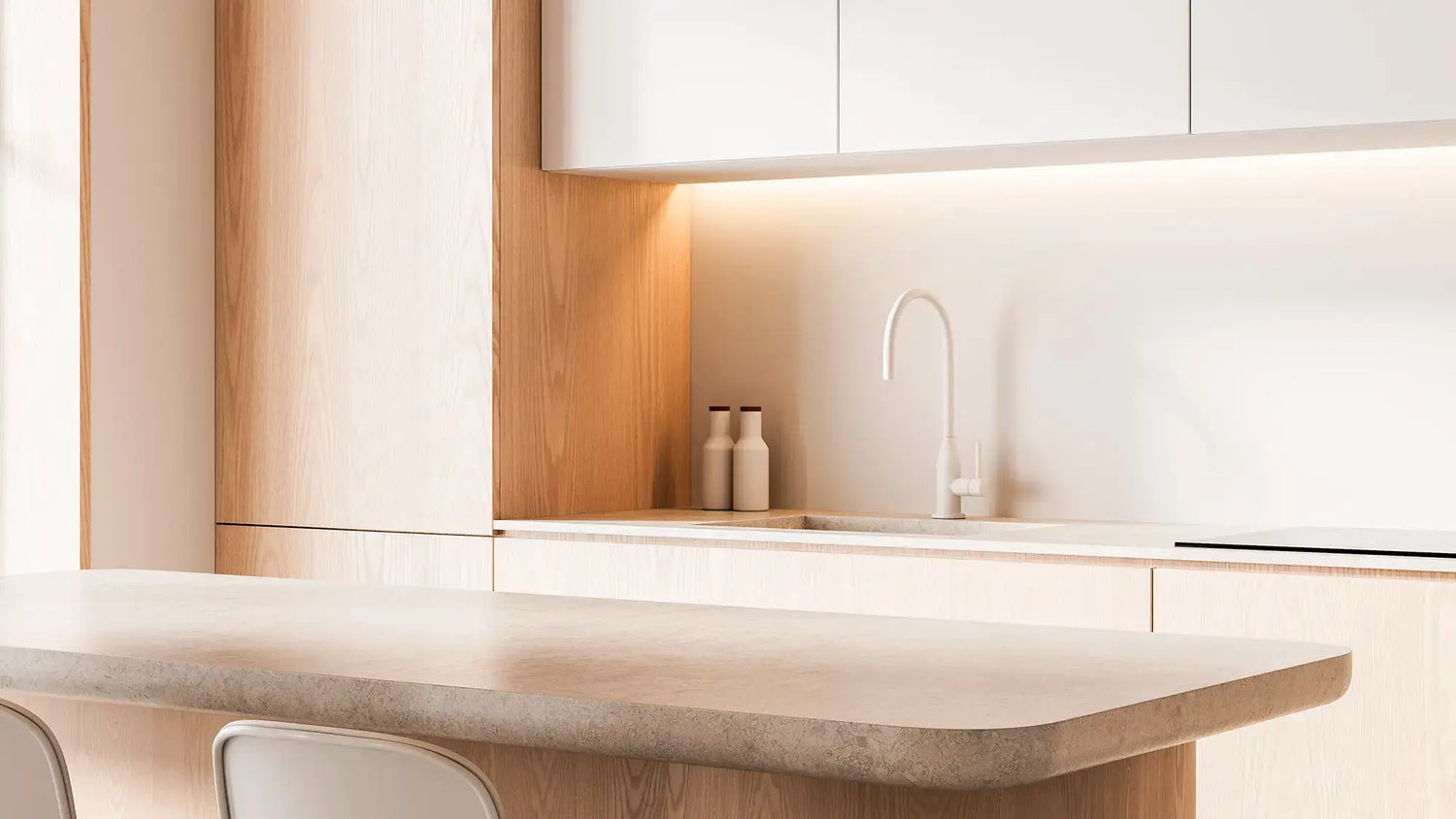
In brief: Effective kitchen lighting is built from three layers: general lighting on the ceiling (downlights, track lights or panel), task lighting for worktops (LED strip in aluminium profile under wall cabinets, approximately 9–14 W/m, CRI 90+, 3000–4000 K) and accent lighting, such as pendant lights above an island or dining table. Control the layers separately and make accent lighting dimmable. You'll find all general, task and accent lights in the kitchen lighting category. Our customer service team will be happy to help plan your complete solution.
Kitchen LED lighting is one of the most important elements in a modern home, as it seamlessly combines practical task lighting with comfortable ambient illumination. By choosing high-quality, dimmable LED strips or spots, you can adjust the space's appearance as needed – from bright cooking light to soft dining ambience.
Properly designed kitchen LED lighting highlights interior design choices and makes the kitchen the most inviting space in the home.

Why Choose Dimmable LED Lighting for the Kitchen?
The kitchen is no longer just a place for cooking – it often serves as the social heart of the home, where we work, spend time with family and entertain guests. For this reason, fixed lighting restricted to a single brightness level is often inadequate. Dimmable kitchen LED lighting offers the flexibility that modern lifestyles demand.
The greatest benefit of dimming is versatility. When you need precision for chopping or reading recipes, you can set the lights to full power. As evening falls and it's time to relax, reducing the light output instantly transforms the space into a calm retreat. Moreover, LED technology is highly energy-efficient. When lights are dimmed, energy consumption decreases further, and the lifespan of the fittings extends, as they don't constantly operate at maximum load.
In a quality installation, such as the solutions we offer, light quality is paramount. A high colour rendering index (CRI > 90) ensures that ingredients and kitchen materials appear natural even in dim light. Dimming should never cause flickering, which is why we only use professional-grade power supplies and controllers that guarantee smooth, eye-friendly performance.
From Task Lighting to Ambient Lighting with a Single Control
Working in the kitchen requires shadow-free, bright light. Kitchen LED lighting installed above worktops is particularly critical for ergonomics. With a dimmable system, the same light source that functions as effective task lighting transforms at the touch of a button into decorative ambient lighting.
Many now choose powerful LED strips for the kitchen, such as 15W/m models. These produce up to 1400 lumens per metre, which is more than sufficient even for demanding tasks. Without dimming, such light output could be dazzling in the evening when you simply want to fetch a glass of water or enjoy a quiet moment. With a dimmer, the light output can be reduced to, say, 10 percent, making it excellent as a night light or indirect decorative lighting.
Smooth dimming is essential. Quality 24V systems enable stepless adjustment without jumps between brightness levels. This creates a luxurious feel as the light glides smoothly from bright to dim. It's also worth noting that dimming affects the spatial depth perception; by highlighting certain parts of the kitchen and leaving others in shadow, you can create dynamic and interesting atmospheres.
Tips for Choosing the Right Colour Temperature
Colour temperature, measured in kelvins (K), determines how warm or cool light feels. Kitchen LED lighting is typically chosen in either neutral white (4000K) or warm white (3000K). The choice largely depends on the kitchen's overall colour scheme and desired atmosphere.
- 4000K (Neutral white): Excellent for modern, white or grey kitchens. It's fresh, increases alertness and is optimal for working, as it renders colours as neutrally as possible.
- 3000K (Warm white): Creates a homely and inviting atmosphere. Particularly suited to wooden surfaces and more traditional interiors. It's gentler on the eyes in the evening.
- CCT-adjustable (2700K–6500K): If you can't decide, a CCT strip is the best solution. It allows you to adjust colour temperature according to time of day: bright, cool light during the day, very warm glow in the evening.
When planning kitchen LED lighting, consider surface finishes. Dark and matt surfaces absorb more light, requiring more powerful fittings, whilst pale and glossy surfaces reflect light, which can cause glare if LED points are visible. This is why we always recommend COB-type LED strips, where the light is completely uniform without visible dots.
LED Strips and Spots: Versatile Light Sources for the Kitchen
Effective and stylish kitchen LED lighting often results from combining different light sources. LED strips are the most popular choice for the kitchen backsplash, whilst spots or downlights work brilliantly as general lighting or to highlight specific features, such as a breakfast cupboard or display cabinet.
LED strips and profiles:
LED strips installed in the backsplash should always be placed in an aluminium profile. A profile such as PINTA10.v2 or SUORA12 not only protects the strip from dirt and splashes, but also acts as a heat sink, extending LED lifespan. The profile cover (diffuser) further smooths the light. Example of a recommended kitchen configuration:
- LED strip: COB 15W/m 24V CRI>90
- Light output: 1400 lm/m
- IP rating: IP20 (for dry areas) or IP65 (if installation is near a water source)
- Profile: SUORA12 with matt cover
LED spots:
If the kitchen has a suspended ceiling, recessed spots are an excellent way to create even general lighting. By choosing dimmable models, you can adjust the kitchen's overall appearance in proportion to the backsplash lighting. You'll achieve a particularly refined result by connecting spots and strips to separate dimmer channels, allowing you to emphasise different layers in the space.
Dimming Control – Remote, Wall Controller or Smart Lighting?
Once you've chosen the perfect kitchen LED lighting solution, it's time to decide how to control it. There are many control methods, and the choice depends on how much automation and ease of use you're seeking.
The traditional approach is to install a wall-mounted rotary dimmer or button that works wirelessly or directly connected to the power supply. This is a reliable and user-friendly choice for all family members. However, if you want to avoid running new cables, a wireless Zigbee or SmartLED 2.4G controller is an excellent alternative. It can be installed anywhere, even directly in the kitchen backsplash or on the side of an island.
Smart homes are current, and many choose a kitchen LED lighting system compatible with Zigbee, Matter or Casambi standards. These enable controlling lights via smartphone or voice commands. You can create preset "scenes", such as:
- "Cooking": All lights at 100% power with neutral white tone.
- "Dinner": Backsplash lights at 30%, general lighting off and warm ambience.
- "Night": Only a small dim light under the island to aid movement.
Whichever control method you choose, always ensure the power supply is dimming-compatible (e.g. Triac, 0-10V or smart control). We can provide expert advice on selecting the control system that suits your specific needs, ensuring the result is reliable and long-lasting.
Three Lighting Layers for the Kitchen
1. General Lighting
Even base lighting for the entire space, usually ceiling-mounted LED downlights, track lights or a panel. General lighting ensures sufficient light for movement and cleaning.
2. Task Lighting
Worktop lighting is the kitchen's single most important layer, because wall cabinets and your own body cast shadows on the worktop if light only comes from the ceiling. LED strips under wall cabinets illuminate the entire worktop evenly. Choose a power output of at least approximately 9.6 W/m and position the strip behind the front edge of the cabinet so the light source isn't visible. More detailed instructions: kitchen backsplash LED lighting.
3. Accent Lighting
Pendant lights above an island or dining area provide focused light and a decorative focal point. Accent lighting particularly benefits from dimming in the evenings.
Kitchen Island Lighting
Islands benefit from combining two layers: LED strips or profiles beneath the island worktop and pendant lights above. A series of two or three smaller pendants distributes light more evenly along the island than a single large fitting.
Frequently Asked Questions
How do you plan kitchen lighting?
Plan three layers: general lighting on the ceiling, task lighting for worktops with LED strips under wall cabinets, and accent lighting such as pendants above an island or table. Control the layers separately and dim accent lighting according to the situation.
What colour temperature for the kitchen?
For task lighting, 3000–4000 K works well: neutral 4000 K renders colours accurately, warm 3000 K is more homely. For accent lighting, 2700–3000 K.
See also our pendant light size and height guide for choosing suitable accent lighting above islands, or the bulb base types guide for selecting spot lamps.
If you have any questions about product selection or would like help building a suitable complete solution, please contact us. We'll be happy to help you find the best solutions for your home.


0 comments