


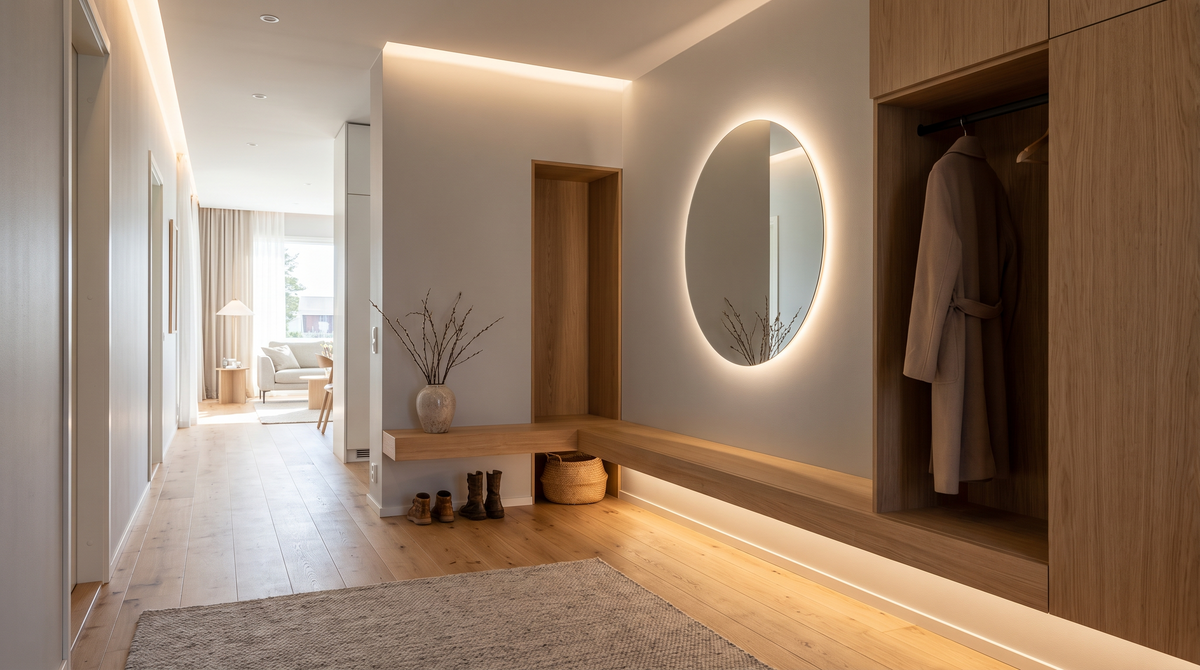
The hallway is the first space you see when entering your home. Well-planned LED hallway lighting makes the space practical, simplifies daily life and creates a calm first impression. Lighting doesn't have to be limited to a single bright ceiling light: often the most effective solution combines general lighting, indirect lighting, mirror lighting and LED strips integrated into furniture.
LED strips are particularly suitable for hallways when you want to position light discreetly beneath a bench, behind a mirror, alongside a cabinet, at ceiling height or in a long corridor. The right LED strip, LED profile, power supply and dimming create a neat and easy-to-use lighting system.
This guide explains how to plan LED hallway lighting, where to position LED strips and how to choose the right colour temperature, profile and controls.
Why Hallway LED Lighting Deserves Careful Planning
The hallway is often a transitional space in the home, but its lighting has a significant impact on everyday functionality. This is where you put on outdoor clothing, search for keys, check your appearance in the mirror and move about frequently during dark hours. Therefore, lighting needs to be sufficiently clear without being harsh or glaring.
A single ceiling light can leave shadowy areas in the hallway, especially if there's a tall cupboard, deep coat recess or long corridor. LED strips can complement general lighting precisely where light is needed. Valotehdas offers LED strips, LED profiles and dimmable solutions to build hallway lighting progressively.
Ambient lighting in a hallway doesn't mean making the space dim. It means directing light gently to the right places. Indirect lighting in a hallway can make even a small space feel more open and help integrate the hallway better with the rest of the home's lighting scheme.
Where to Position LED Strips in a Hallway
LED strip placement determines whether the final result looks considered or disjointed. In hallways, it's generally best to avoid bare LED strips visible directly to the eye. Better results come from hiding the strip in a profile, behind furniture or in an indirect reflective structure.
- Behind or beside a mirror: soft backlighting makes the hallway mirror more striking and helps define the space.
- Under a seat or hallway bench: low-level LED strips work as pathway lighting and lighten the appearance of furniture.
- Under a shoe cabinet or coat rack: light helps locate shoes and items without needing to illuminate the entire space brightly.
- At ceiling height or behind coving: indirect light reflects off the wall or ceiling and makes the hallway softer.
- In a long corridor: corridor LED lighting can be implemented as a continuous line of light that guides movement.
- At the start of or alongside stairs: hallway and staircase lighting should be coordinated if the spaces connect.
If installing LED strips in visible locations, use an LED profile with an opal diffuser. The profile finishes the installation, protects the strip and makes the light more uniform. Explore Valotehdas's LED profiles and LED lists when planning your hallway LED strip installation.
Indirect Lighting Makes Hallways Softer
Indirect lighting works particularly well in hallways if the space is narrow, low-ceilinged or otherwise prone to shadows. When light is reflected off a wall, ceiling or furniture surface, the result feels calmer than direct spotlighting.
Indirect LED hallway lighting can be achieved at ceiling height, behind mirrors, along the top of cabinets or beneath benches. The light's purpose may be creating atmosphere, but it can simultaneously function as pathway lighting during evenings or at night.
More ideas can be found in Valotehdas's mood lighting products and the indirect lighting guide. These solutions can be adapted to hallways, corridors, living rooms and stairways.
LED Strips for Hallways: Power, Colour Temperature and Light Quality
Hallways don't always require very powerful LED strips. Light output is chosen according to whether it's task lighting, pathway lighting or ambient lighting. If an LED strip is the sole light source in a long corridor, more light output is needed than for a low-level night light beneath a bench.
Colour temperatures of 2700K and 3000K often suit a homely hallway. 2700K is warm and soft, while 3000K gives a slightly clearer but still warm impression. 4000K can work if you want a very neutral and clear hallway, but in a small domestic entrance it may feel rather bright compared to other rooms' lighting.
If the hallway connects directly to the living room or kitchen, colour temperature should be coordinated with these spaces. Valotehdas's colour temperature guide helps compare 2700K, 3000K and 4000K differences in practice.
Profiles and Dimming Complete the Installation
An LED profile is often as important as the LED strip itself in a hallway. The profile creates a finished installation and protects the strip from dust, contact and mechanical stress. In hallways, lights are often near furniture, shoes and clothing, so a neat and protected installation is a practical choice.
Dimming increases the usability of hallway lighting. During the day and when cleaning, light can be brighter, but in the evenings a lower light level often suffices. Dimmable LED lighting also works well when the hallway connects to the living room and you want to avoid too strong a contrast between spaces.
When planning dimming, the LED strip, power supply and controller must be compatible. Read more in Valotehdas's guide Dimmable LED Without Flicker. For LED strip selection, a good starting point is also the 24V LED strips category, especially if the hallway requires several metres of LED strip.
Corridor LED Lighting and Connection to Stairs
In many homes, the hallway continues into a corridor or staircase. In such cases, lighting should be planned as a unified whole. Corridor LED lighting can guide movement, highlight wall surfaces or provide low-level pathway lighting at floor or furniture level.
In connection with stairs, lighting also has a safety function: steps are easier to see when light is positioned correctly without dazzling those passing. Hallway LED strips and staircase LED lighting can be implemented with the same colour temperature and profile type so the whole appears unified.
Also read Valotehdas's article LED Stair Lighting – A Safe and Striking Solution for the Home and explore staircase and floor lighting products.
Further Reading on Hallway and Home LED Lighting
If you're planning hallway lighting, these related topics will also be useful for other areas of the home. Continue with these articles:
- Mood Lighting for the Home
- Indirect Lighting with LED Strips
- Indirect Living Room Lighting with LED Strips
- Warm or Neutral Light for the Home?
- Colour Temperatures in Lighting
Common Mistakes in Hallway LED Lighting
One common mistake is using only a single ceiling light in the hallway. This may illuminate the floor but leave the mirror, cabinets and side walls in shadow. Another mistake is installing LED strips visibly without profiles, leaving light points and wiring obtrusively exposed.
A third mistake is choosing a colour temperature too cool relative to the rest of the home. If the living room and kitchen use warm 2700–3000K light, very neutral hallway lighting can feel disconnected. A fourth mistake is forgetting dimming, even though hallways are used differently at different times of day.
A fifth mistake relates to power supply and control placement. The power supply must be in an accessible location for maintenance and shouldn't be permanently hidden in the structure. Fixed electrical installations should be carried out by a qualified electrician.
Frequently Asked Questions About Hallway LED Lighting
What colour temperature suits a hallway?
For most domestic hallways, 2700K or 3000K works well. 2700K is soft and warm, 3000K slightly clearer but still homely. If the hallway also functions as a corridor or work area, 4000K may be worth considering.
Can LED strips be installed under a hallway bench?
Yes. LED strips installed under a bench work well as low-level pathway and ambient lighting. The strip should be installed in a profile so the light looks neat and the strip is better protected.
Is an LED profile necessary in a hallway?
An LED profile is recommended especially for visible installations or those exposed to contact. It protects the LED strip, aids heat management and makes the light more uniform.
Are dimmable LEDs suitable for hallways?
Yes. Dimming makes hallways more flexible: brighter light works for cleaning and getting dressed, lower light for evenings and night-time.
How should corridor LED lighting be positioned?
In corridors, LED strips can be positioned at ceiling height, along wall lines, under furniture or near floor level. The key is that light guides movement without shining directly into eyes.
Can hallway and staircase lighting be unified in style?
Yes. When hallways and stairs use the same colour temperature, similar profile types and unified controls, the spaces connect more naturally.
Start Planning Your Hallway LED Lighting
Hallway LED lighting works best when you plan light placement before selecting products. First decide whether light is needed for mirrors, cabinets, beneath benches, in corridors or as indirect lighting at ceiling height. Then choose the appropriate LED strip, profile, power supply and any dimming.
Explore Valotehdas's warm 24V LED strips, LED profiles, dimmable solutions and mood lighting products. This way you'll create a functional, comfortable hallway that coordinates with the rest of your home.


0 comments