


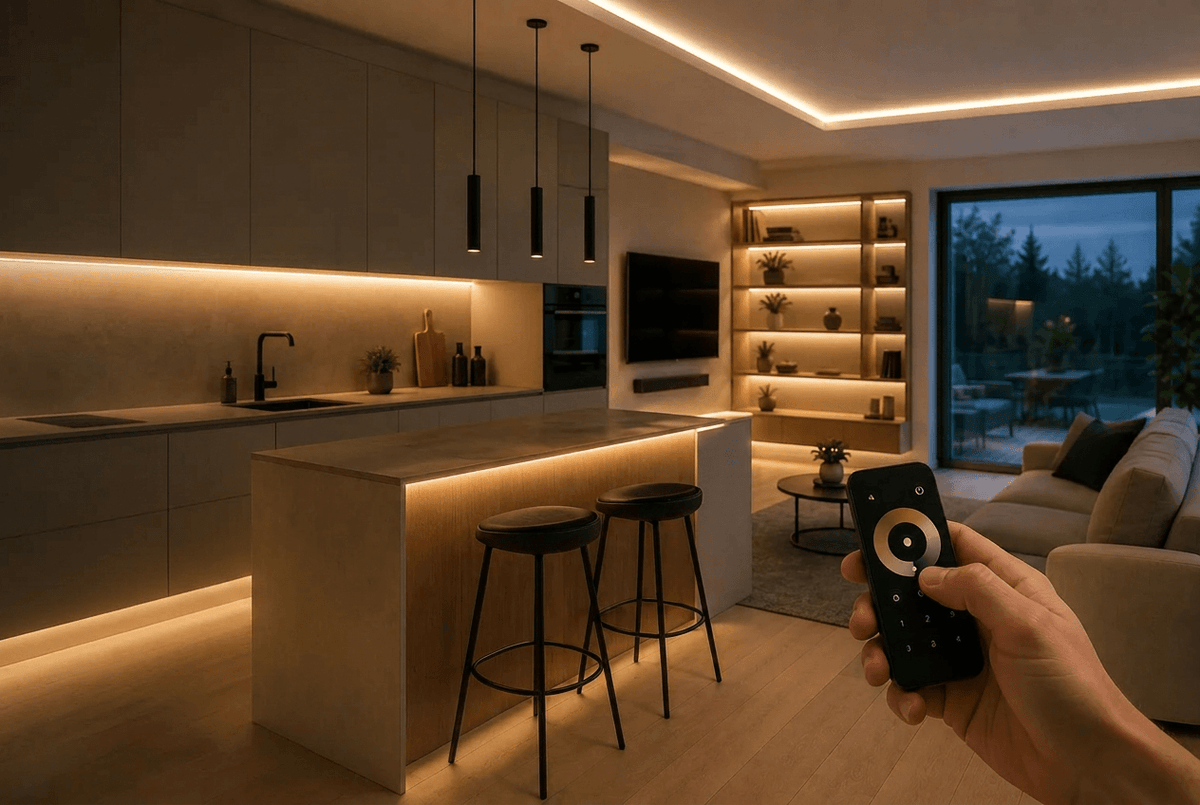
In brief: Choose LED strip lights based on application (kitchen, living room, outdoor), voltage (12V, 24V or 48V), light output, colour temperature (2700K–4000K), CRI value, IP rating and profile type. COB LED strips produce uniform light lines ideal for visible installations. Match LED strips with compatible drivers, profiles and controllers. Plan the complete system before ordering to ensure compatibility and professional results.
LED strip lights are one of the most versatile ways to create neat, energy-efficient and adaptable lighting for homes, kitchens, terraces, furniture, retail spaces and workplaces. However, the same product category can mean very different solutions: low-power ambient lighting, effective task lighting, moisture-resistant outdoor lighting, RGBW accent lighting or custom-sized light lines for project installations.
From a buyer's perspective, the challenge is that LED strip lights are often compared solely on price or wattage. In practice, a successful outcome depends on a much broader set of factors: the type of LED strip, voltage, colour temperature, CRI value, profile, driver, control system and installation environment. This guide brings together the key considerations for choosing the best LED strip lights for home and commercial use.
Understanding LED strip light specifications
When choosing LED strip lights, several technical specifications determine whether the product suits your application. The most important factors are voltage, power per metre, light output (lumens per metre), colour temperature, colour rendering index (CRI) and protection rating (IP).
Voltage affects strip sizing, cabling and voltage drop management. In domestic applications, 12V and 24V are common. For longer runs, 24V is often a practical solution as it helps manage voltage drop compared to shorter 12V installations. 48V solutions may be appropriate in certain longer or more technical applications when products and drivers are correctly selected.
Power per metre indicates how much energy the strip consumes and generally correlates with light output. For kitchen worktops, 12–15W/m is typically recommended, whilst 5–9.6W/m is sufficient for ambient lighting alone. Always check the actual lumen output rather than relying solely on wattage.
Lumens per metre measure actual light output. A 15W/m COB strip can produce up to 1,400 lumens per metre, providing effective task lighting. Lower-output strips (300–600 lm/m) work well for indirect or accent lighting.
Colour temperature and colour rendering
Colour temperature affects how a space feels and should be chosen according to the room's materials and intended use. Measured in Kelvin (K), common values include:
- 2700K: Warm and soft, suited to living rooms, bedrooms, ambient lighting and display cases
- 3000K: Warm but clear, ideal for kitchens, cabinets, general use and terraces
- 4000K: Neutral white, working well for work areas, utility rooms, offices and retail spaces
Colour temperature alone doesn't tell the whole story. The CRI (Colour Rendering Index) indicates how naturally light reproduces colours. An LED strip may be 3000K, but if colour rendering is low, food, wood surfaces, textiles or products may look flatter than under higher-quality light. Always choose CRI >90 for kitchens, dining areas, wardrobes, retail spaces and anywhere colour accuracy matters. Premium components guarantee consistent colour temperature along the entire strip length and accurate colour reproduction.
For maximum flexibility, tunable white (CCT) strips allow you to adjust colour temperature from warm (2700K) to cool (5000K) to suit different times of day or activities. RGB strips produce coloured light, whilst RGBW and RGB+CCT strips combine colour-changing capability with quality white light.
COB LED strips versus traditional SMD strips
COB (Chip on Board) LED strips have become increasingly prominent because they produce a more uniform light line than traditional dotted SMD (Surface Mounted Device) LED strips. In COB technology, multiple LED chips are bonded directly to the circuit board and covered with a continuous phosphor layer, creating a completely smooth and unbroken line of light without individual dots. This is particularly useful in kitchens, cabinets, shelves and other visible installations where the LED strip or its reflection is directly visible to the user.
Traditional SMD LED strips still work well in many applications. They are well suited to indirect lighting, applications where individual LED dots are not directly visible, and situations where the product's technical characteristics match the usage requirements. COB LED strips are often the natural choice when the most uniform possible light line in a low profile is desired.
| Feature | COB LED strip | Traditional SMD LED strip |
|---|---|---|
| Light line | Uniform, individual dots not visible | LED dots may be visible depending on profile |
| Applications | Kitchens, shelves, display cases, visible light lines | Indirect lighting, technical applications, concealed installations |
| Profile requirement | Recommended for finishing and protection | Recommended especially for visible installations |
| Selection basis | Light uniformity and finished appearance | Application, light output and value for money |
Explore Light Factory's COB LED strips and standard LED strip lights for applications where visual finish is an important part of the lighting. For more detail, read What is a COB LED strip?
IP ratings and outdoor use
The IP (Ingress Protection) rating indicates the luminaire's protection against water and dust. The first digit refers to solid particles (dust), the second to liquids (water). Common ratings for LED strips include:
- IP20: No protection, for dry indoor use only
- IP65: Dust-tight and protected against water jets, suitable for some outdoor and wet-room applications
- IP67: Dust-tight and protected against temporary immersion, suitable for demanding outdoor and sauna applications
For outdoor LED strips, ensure the IP rating suits the installation location. Covered terraces may require only IP65, whilst exposed locations benefit from IP67. In saunas, temperatures can reach one hundred degrees, which would destroy an ordinary LED strip instantly. For sauna lighting, you must use specially designed, heat-resistant products rated IP65 or IP67 protected with silicone that withstands heat and moisture. Read the full sauna LED lighting guide for more.
Remember that drivers and control units must be placed in dry locations or installed in appropriate watertight enclosures. Professional design ensures that the lighting is not only beautiful but also compliant with electrical safety regulations.
Quick-selection table by room and application
| Application | Recommended LED strip | Colour temperature | Power | Key considerations |
|---|---|---|---|---|
| Kitchen worktop | 24V COB or dense LED strip | 3000K or 4000K | 12–15 W/m | Use aluminium profile and opal cover to control glare |
| Living room indirect lighting | Lower or medium-power LED strip | 2700K or 3000K | 5–9.6 W/m | Dimming makes use more flexible |
| Cabinets and display cases | COB LED strip or low-power LED strip | 2700K–3000K | 4.8–9.6 W/m | Light should be soft and not shine directly into eyes |
| Stairs and walkways | Low-power LED strip in profile | 2700K–3000K | 4.8–9.6 W/m | Light direction and safe installation are key |
| Terrace and outdoor areas | IP65/IP67 outdoor LED strip | 2700K–3000K | 9.6–12 W/m | Check IP rating, driver and installation environment |
| Office workstation | 24V LED strip in profile | 3000–4000K | 9.6–16 W/m | Dimming or smart control recommended |
| Retail shelf | CRI 90+ LED strip | 3000–4000K | 9.6–16 W/m | Colour rendering, uniformity and maintainability matter |
For detailed kitchen installation advice, read the kitchen under-cabinet LED strip lighting guide.
Aluminium profiles and diffusers
An LED strip should generally not be installed in a visible location without an aluminium profile. The profile protects the LED strip, assists with heat management, keeps the strip straight and enables the use of a diffuser. A diffuser or cover softens the light and reduces the visibility of individual LED dots, which is essential even for COB strips in shallow profiles or near reflective surfaces.
| Profile type | Application | Benefit |
|---|---|---|
| Surface-mounted profile | Kitchens, shelves, cabinets, retrofit installations | Easy to install and maintain |
| Recessed profile | Furniture, walls, ceilings and custom solutions | Discreet and finished result |
| Corner profile | Worktops, display cases, stairs and shelves | Directs light precisely where needed |
| Deep profile | Visible light lines | Helps create more uniform light |
Aluminium profiles aren't just an aesthetic choice; they act as heat sinks that conduct heat away from the LEDs. This prevents premature dimming and burnout of the diodes, ensuring long service life. LED strips, profiles and diffusers should be selected together to ensure the strip fits the profile, the diffuser suits the application and the complete installation looks finished.
Drivers and sizing
An LED strip always requires the correct driver (also called a power supply or transformer). Driver selection is influenced by the LED strip's voltage, length and power per metre. Additionally, an appropriate power reserve (20–30%) is left in the driver so it doesn't constantly operate at its limits, which improves reliability and lifespan.
| Item to calculate | Example | Interpretation |
|---|---|---|
| LED strip length | 5 metres | Measure from installation location before ordering |
| Power per metre | 10 W/m | Product-specific value |
| Total power | 5 m × 10 W/m = 50 W | Driver is sized according to this |
| Driver selection | 24V, minimum 60–65W | Voltage and power selected to match LED strip with reserve |
Check driver sizing before ordering, especially if LED strips will be installed in multiple locations, dimming is used, or the installation involves long cable runs. For longer runs (tens of metres), feed power from multiple points or use a higher voltage (24V or 48V) to manage voltage drop. For step-by-step guidance, read the LED strip driver sizing guide.
Control systems: dimmers, smart control and automation
No demanding lighting project is complete without intelligent control. Quality drivers and controllers enable smooth dimming down to 0.1% without flickering. This is particularly important in spaces where time is spent in the evenings, such as the living room or home cinema.
Dimming methods include:
- TRIAC dimming: Works with traditional wall dimmers; ensure driver compatibility
- PWM (Pulse Width Modulation): Used with low-voltage LED strips via a PWM controller between strip and driver
- 0–10V / 1–10V: Common in commercial applications
Smart control enables LED strips to be integrated into a smart home via wireless standards such as Zigbee, Matter and Casambi. This allows lights to be controlled via phone, voice or wireless switches without complicated cabling. An LED strip is not inherently "Casambi-compatible" or "Zigbee-compatible"; compatibility comes from the correct controller, driver and strip.
A typical smart complete system comprises:
- 24V LED strip (single colour, CCT, RGB or RGBW)
- 24V constant voltage driver
- 24V PWM controller (Zigbee, Casambi or other protocol) with sufficient load capacity
- Profile and diffuser
For CCT strips, a 2-channel controller is required; for RGBW strips, a 4-channel controller. Always verify voltage, load and channel compatibility before ordering. Wireless solutions offer control options such as timers, motion sensors and preset lighting scenes.
Practical tips for successful installation
Successful lighting requires careful advance planning. Here are the most important tips to help you avoid common pitfalls:
- Measure and plan: Calculate the required metreage and ensure the driver has sufficient power reserve (approximately 20–30%).
- Use profiles: An aluminium profile protects the strip from mechanical stress and improves cooling, which extends service life.
- Consider voltage drop: If you're installing tens of metres of strip, feed power from multiple points or use a higher voltage (24V or 48V).
- Choose the right colour temperature: Consider the purpose of the space. 3000K is warm and inviting, 4000K neutral and fresh.
- Test before final installation: Connect the LED strip to the driver and verify that everything works and the tone is as desired before sticking it permanently into the profile.
- Plan cable routes: Route cables neatly and ensure connections are accessible for future maintenance.
- Check IP ratings: Ensure strips and drivers match the installation environment (dry, damp or wet).
Most common mistakes when purchasing LED strip lights
- LED strip selected solely on price without checking CRI, lumen output or warranty
- Driver sized too small without power reserve
- 12V and 24V products mixed in the same system
- LED strip installed in a visible location without aluminium profile
- Colour temperature doesn't match other lighting in the space
- Dimming not considered before installation
- Cable routes planned only during installation
- Ignoring IP rating in wet or outdoor locations
Light Factory helps avoid these mistakes by offering product information, guides and customer service. When you select LED strips, profiles, drivers and controls from the same complete system, compatibility is easier to ensure.
Comparing LED strip lights: price versus features
LED strip lights are available at different price points in the market. However, price tells only part of the story. When comparing the best LED strip lights for home or commercial use, also check:
- Light output (lumens per metre): Affects whether light is sufficient for the application
- Colour rendering (CRI): Critical for colour accuracy in kitchens, retail and display cases
- Warranty: Light Factory offers a 5-year warranty on LEMLUX LED strips
- Compatible accessories: Profiles, drivers and controllers should form a complete system
- Customer service: Expert assistance reduces risk of purchasing errors
High-quality lighting is an investment that improves quality of life, enhances property value and lasts tens of thousands of hours without significant light output degradation. When components are correctly selected and installed in structural elements, replacement becomes unnecessary for many years.
Browse Light Factory's LED strip lights, aluminium LED profiles, LED drivers and control accessories. EU delivery typically takes 3–8 days. For assistance, contact Light Factory customer service at asiakaspalvelu@valotehdas.fi or call 010 311 2830. The Light Factory showroom at Ajurintie 2, 03100 Nummela supports product selection when you want to see the lighting in practice before making a purchase decision.
Frequently asked questions
Which LED strip lights suit a kitchen?
For kitchen worktops, a 24V COB LED strip or dense LED strip in an aluminium profile with an opal diffuser is often suitable. Choose 12–15W/m with colour temperature 3000K or 4000K and CRI >90 for accurate colour rendering. The profile controls glare and protects the strip. Read the full kitchen under-cabinet LED strip lighting guide for detailed installation advice.
What's the difference between COB and SMD LED strip lights?
COB (Chip on Board) LED strips produce a completely uniform light line where individual LED dots are not visible, ideal for visible installations in kitchens, cabinets and shelves. Traditional SMD (Surface Mounted Device) LED strips have separate LED dots that may be visible depending on the profile. SMD strips work well in indirect lighting or applications where the strip is concealed. Learn more in What is a COB LED strip?
How do I size an LED driver?
Multiply the LED strip length by its power per metre. For example, 5 metres of 10W/m strip = 50W total. Select a driver with 20–30% power reserve (minimum 60–65W in this example). The driver voltage must match the LED strip voltage (12V, 24V or 48V). For long runs, consider feeding power from multiple points. Read the LED strip driver sizing guide for step-by-step instructions.
Can LED strip lights be dimmed?
Yes, if the LED strip, driver and dimmer are compatible. Quality drivers and controllers enable smooth dimming down to 0.1% without flickering. TRIAC dimmers work with traditional wall dimmers, whilst PWM controllers enable wireless smart control via Zigbee, Casambi or other protocols. Dimming should be planned before ordering products to ensure compatibility.
What IP rating do I need for outdoor LED strips?
For covered outdoor areas such as terraces, IP65 is generally sufficient. For exposed locations or areas subject to rain, choose IP67. In saunas, use heat-resistant IP65 or IP67 strips protected with silicone. Always ensure drivers and controllers are placed in dry locations or appropriate watertight enclosures. Browse outdoor LED strips for suitable products.
Do LED strips always need an aluminium profile?
In visible and long-term installations, an aluminium profile is strongly recommended. It protects the LED strip from mechanical stress, acts as a heat sink to extend LED lifespan, keeps the strip straight and enables the use of a diffuser to soften the light. Profiles are essential even for COB strips in shallow installations or near reflective surfaces. Explore aluminium LED profiles to complete your installation.
How do I connect LED strips to smart home control?
LED strips are not inherently smart; compatibility comes from the correct controller. Choose a PWM controller (Zigbee, Casambi or other protocol) compatible with your LED strip voltage (typically 24V) and with sufficient load capacity for the strip's total power. Single-colour strips need 1-channel controllers, CCT strips need 2-channel controllers and RGBW strips need 4-channel controllers. A typical system comprises: 24V LED strip + 24V constant voltage driver + 24V smart PWM controller + profile and diffuser.


0 comments