


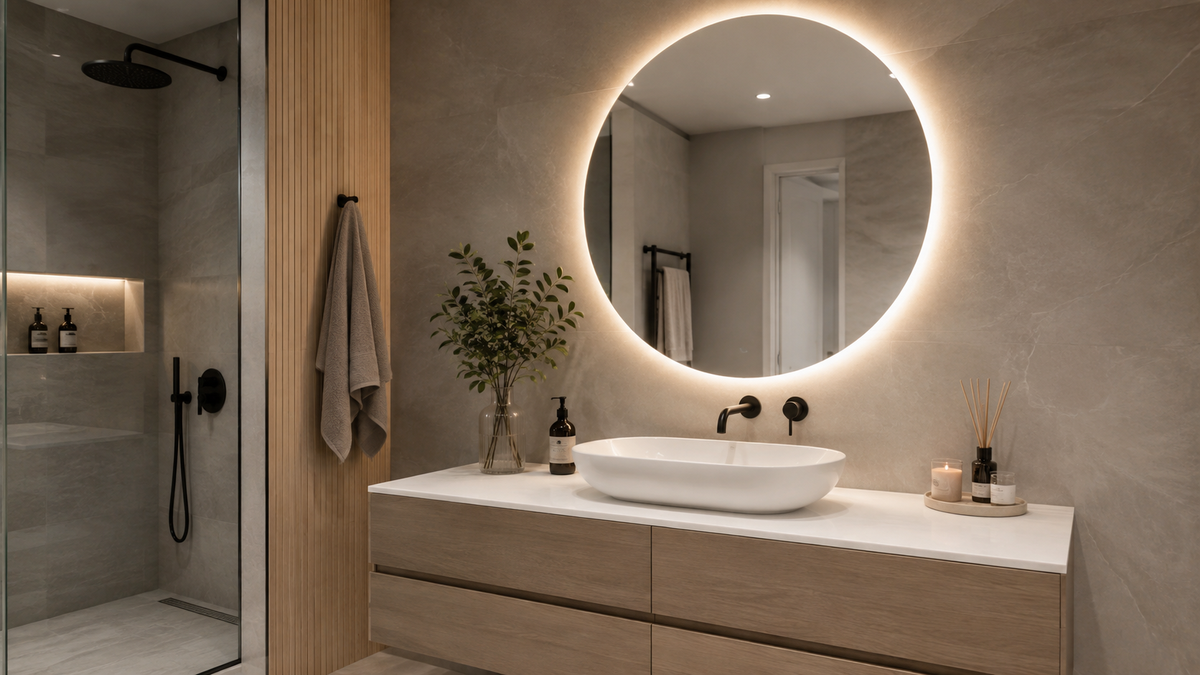
Bathroom Mirror Lighting with LED Solutions
Bathroom mirror lighting with LED solutions is one of the most practical ways to improve bathroom comfort. LED lighting installed around or behind a mirror helps with daily tasks such as washing your face, shaving, applying makeup and styling hair. At the same time, it can make the bathroom feel softer and more finished.
Good mirror lighting doesn't come from an LED strip alone. In bathrooms, you also need to consider IP rating, light colour temperature, dimmability, power supply placement and a suitable LED profile. When these are chosen correctly, the result is tidy, safer and pleasant in everyday use.
This guide covers how to choose an LED strip for behind your mirror, what IP rating to consider for bathroom lighting and which products you need for functional LED mirror lighting.
Why Choose LED Mirror Lighting for Your Bathroom
The light around a mirror directly affects how well you can see your face and details. A single ceiling light often isn't enough, as the light may remain behind you or cast shadows on your face. LED mirror lighting brings light closer to where you need it and helps make daily tasks in front of the mirror easier.
LED strips are particularly suitable for mirrors when you want a tidy and discreet solution. The strip can be installed behind the mirror, along the mirror sides, under a mirror cabinet or in a profile around the mirror. When installed behind the mirror, the light reflects off the wall surface and creates soft indirect lighting.
Bathroom ambient lighting with LED solutions also works well for evening use. When the light isn't too bright or glaring, the bathroom feels calmer, for instance after an evening wash or sauna.
Choosing an LED Strip for Behind the Mirror – Practical Tips
Choosing an LED strip starts with its intended use. If you want mirror lighting that actually allows you to see your face clearly, weak ambient light alone won't necessarily suffice. However, if the goal is soft background light around the mirror, a more moderate LED strip may be a good choice.
For LED strips behind mirrors, consider at least these factors:
- Voltage: 24V LED strips are often a practical choice for slightly longer runs.
- Light output: Mirror lighting requires more light than ambient lighting alone.
- Colour temperature: 3000K gives a warm and homely tone, 4000K a more neutral and clearer impression.
- Colour rendering: Good colour rendering helps skin, hair and bathroom surface materials look more natural.
- IP protection: In bathrooms, moisture protection must be chosen according to the installation location.
If the LED strip remains visible or you want the light to be as uniform as possible, consider an LED profile with an opal cover. Profiles for LED strips make installations tidier and help protect the LED strip.
The Importance of IP Rating in Bathroom Lighting
IP rating indicates how well a luminaire or LED solution is protected against dust and water. In bathrooms, IP rating is important because the space may be exposed to moisture, splashes and water vapour. Valotehdas's bathroom IP rating article covers this in more detail and makes good further reading before selecting products. Read more: LED Lighting for Bathrooms – What IP Rating Do You Need?
Not all areas of a bathroom require the same level of protection. The mirror area, under mirror cabinets, near showers and ceiling zones all have different risk levels. The closer a luminaire is to direct splashing water, the more carefully the IP rating and installation method must be planned.
Valotehdas's bathroom lighting page states that the range includes luminaires and LED strips suitable for high IP ratings in bathrooms. Products suitable for bathroom use should always be examined on a product-by-product basis, as IP rating, operating temperature and installation method vary between products.
Fixed electrical installations and mains voltage connections should be carried out by qualified electricians. This is particularly important in bathrooms, as damp spaces place stricter requirements on installations than usual.
Dimmable LED and Lighting Atmosphere
Dimmable LED is an extremely useful feature for bathroom mirror lighting. In the morning, the light can be used brighter, whilst in the evening the mirror light can be dimmed to softer levels. This makes the same LED solution more versatile.
When planning dimming, you must ensure that the LED strip, power supply and dimmer are compatible. Not all LED power supplies are dimmable, and not all LED strips can be controlled with any controller.
If the goal is dimmable LED without flicker, choosing the right dimmer and power supply is an important part of the whole system. Read Valotehdas's guide on flicker-free dimmable LED lighting.
Light Colour Temperature Around the Mirror
Light colour temperature affects how the bathroom feels and how your face appears in the mirror. Excessively warm light may look atmospheric, but it's not always the best choice for precise mirror work. Excessively cool light can feel harsh and unpleasant.
In most bathrooms, 3000K or 4000K is a practical choice. 3000K gives a slightly warmer atmosphere, whilst 4000K is more neutral and clearer. If the bathroom has multiple luminaires, the mirror lighting tone should be matched to the general lighting so the overall effect doesn't look patchy.
Valotehdas's colour temperature guide helps you understand how 2700K, 3000K and 4000K differ in practice. Valotehdas's bathroom lighting page recommends paying attention to the Kelvin value and using the same colour temperature for general lighting and mirror luminaires.
Installation and Suitable Profiles for Mirror Lighting
LED strips can be installed behind mirrors so the light reflects indirectly off the wall. This creates a soft and atmospheric result. If more light is needed on the face, backlighting alone may not always suffice. In such cases, a separate lighting solution may be needed along the mirror sides or above.
LED profiles help finish the installation. A profile protects the LED strip, supports heat management and makes the light more uniform. Suitable profiles for mirror lighting often include low surface-mounted profiles, narrow profiles or profile solutions designed for damp spaces.
From Valotehdas you'll find general LED profiles / LED lists as well as a category aimed at bathroom use for bathroom LED profiles and indirect lighting.
The power supply must be placed somewhere protected from moisture and accessible for future maintenance. The protection rating and installation location of power supplies chosen for damp spaces should be checked on a product-by-product basis. If in doubt, verify the complete system with a qualified electrician before installation.
Recommended Product Categories for Mirror Lighting
Bathroom mirror lighting with LED strips usually consists of four parts: LED strip, profile, power supply and possible dimmer or controller. Valotehdas's webshop stocks products for bathroom LED lighting, damp spaces and LED strip installations.
- Bathroom LED Lighting – LED solutions suitable for damp spaces.
- 24V LED Strips – a common choice for mirror lighting and longer LED runs.
- Bathroom LED Profiles – profile solutions for damp spaces and indirect lighting.
- LED Profiles / LED Lists – general profile range for LED strips.
- LED Transformers and Power Supplies – power supplies for LED strips and other LED solutions.
Common Mistakes in Mirror Lighting
The first common mistake is choosing only backlighting and expecting it to work as precise facial lighting. An LED strip installed behind a mirror creates beautiful indirect light, but the face may still remain in shadow if insufficient light comes from the front or sides.
The second mistake is failing to check the IP rating. In bathrooms, products must be suitable for the installation location. This is particularly important near showers, basins and splashing water.
The third mistake is choosing different colour temperatures in the same small space. If the ceiling light is 4000K and the mirror light is 2700K, the overall effect can look uneven. Consistent colour temperature makes the bathroom look more finished.
The fourth mistake is forgetting about power supply placement. Power supplies shouldn't be hidden permanently in structures from which they cannot be serviced. Additionally, the installation location in damp spaces must be chosen correctly.
The fifth mistake is acquiring dimming as an afterthought. If you want adjustable mirror lighting, ensure before ordering that the LED strip, power supply and dimmer are compatible.
Frequently Asked Questions About Mirror Lighting
Why is IP rating important for mirror lighting?
IP rating indicates how well a luminaire or LED solution withstands dust and water. In bathrooms, moisture and splashes must be considered, so IP rating is always chosen according to the installation location.
Can LED light be dimmed in bathrooms?
Yes, when the LED strip, power supply and dimmer are compatible. Dimming should be planned before ordering products so the light works correctly without interference.
Which colour temperature suits bathroom mirror lighting best?
3000K suits a warmer and softer atmosphere. 4000K is a more neutral and clearer tone for working in front of the mirror. Often the same colour temperature should be maintained throughout the bathroom.
How do I install an LED strip safely behind a mirror?
Measure the back of the mirror, choose an IP rating suitable for the installation location, use an LED profile if necessary and ensure correct power supply placement. Fixed electrical installations should be carried out by qualified electricians.
Is an LED profile needed for mirror lighting?
An LED profile is recommended because it protects the strip, improves heat management and finishes the light's appearance. For indirect lighting behind mirrors, a profile helps keep the installation tidy.
What common mistakes in mirror lighting should be avoided?
Avoid incorrect IP rating, insufficient light output, incompatible dimming, mixing different colour temperatures and placing the power supply where it cannot be serviced.
Choose Bathroom LED Mirror Lighting as a Complete System
Bathroom mirror lighting with LED solutions works best when the LED strip, profile, power supply, IP rating and possible dimming are considered as one complete system. An LED strip installed behind a mirror can bring soft atmosphere to the bathroom, but practical mirror lighting also requires sufficient light output and correct light direction.
Explore Valotehdas's bathroom LED lighting products, 24V LED strips, bathroom LED profiles and LED transformers. Choose products according to installation location, IP rating and usage requirements, and mirror lighting will work in everyday life exactly as it should.


0 comments