


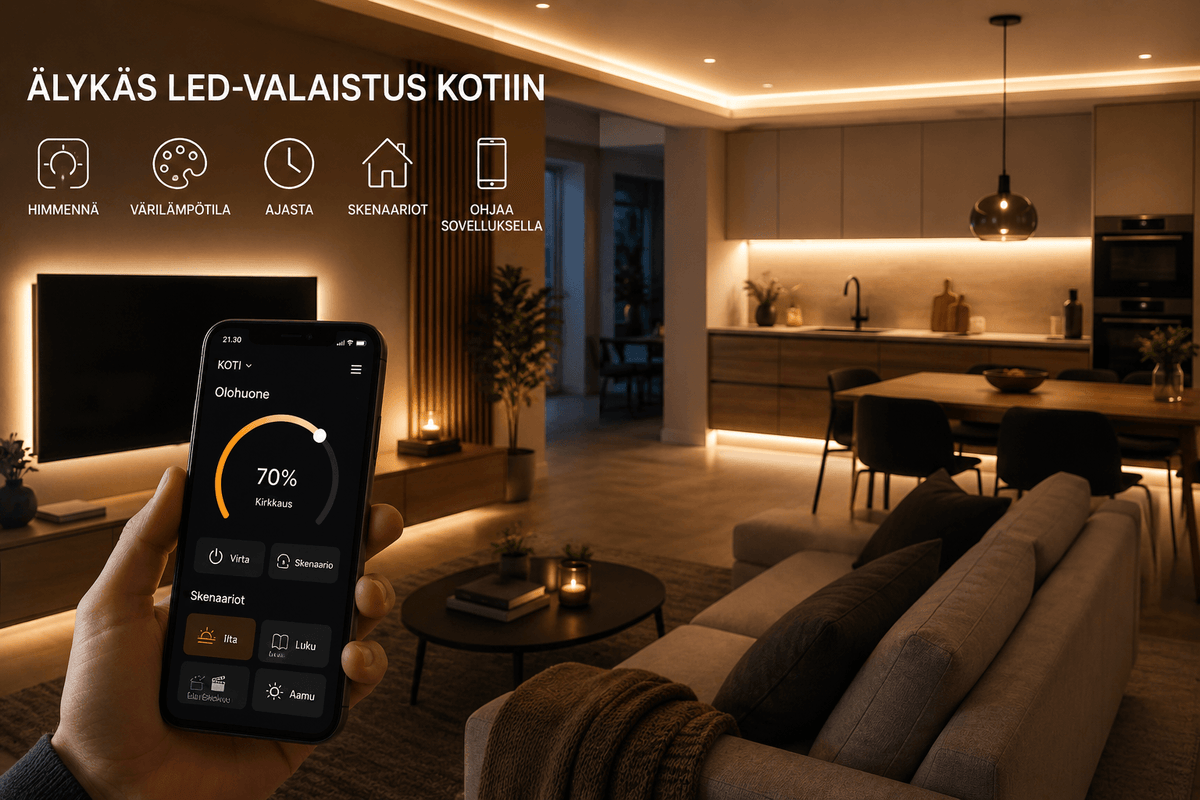
In brief: LED lighting is usually controlled smartly in four ways. TRIAC dimming works with an ordinary 230V wall dimmer and a dimmable power supply. Zigbee is a wireless smart home network controlled via a hub (such as Hue Bridge or Home Assistant) and app. Matter is a new standard that allows devices from different manufacturers to work together. Casambi controls lights via Bluetooth from an app without a hub. The easiest way to start is with one dimmable lighting group, such as a kitchen LED strip. Read more: TRIAC, Zigbee, Matter and Casambi.
Smart LED lighting for the home sounds complicated, but you can often get started with a very small change. It's not about having to renew your entire home's lighting all at once. Often the most sensible approach is to start with one room, one practical need or one lighting group where smart control offers immediate practical benefits.
Smart lighting at home might mean, for example, a dimmable LED strip in the kitchen backsplash, mood lighting in the living room, scheduled outdoor lighting, motion-activated hallway lighting or phone-controlled indirect lighting in the bedroom. At its best, smart home lighting makes everyday life easier, more adjustable and more pleasant.
This guide covers where beginners should start with smart home lighting, what different control methods you need to understand, and how to plan LED control at home so that products work together.
What Does Smart LED Lighting Mean in Practice?
Smart LED lighting means lighting that can be controlled in ways other than with a traditional wall switch. Control can happen, for example, via a phone app, remote control, wireless button, motion sensor, timer or as part of a broader smart home system.
Smart lighting doesn't always mean colour-changing lights or complex automations. For many homes, the most important benefit is far more everyday: you can dim the light, create preset lighting scenes for different rooms and make lights work more flexibly without major changes to electrical installations.
A good starting point is to think about what problem you want the lighting to solve. Is there too little light on the kitchen worktop? Is the living room's general lighting too bright in the evenings? Do you want calming mood lighting in the bedroom? Or do you need timers or remote control for outdoor lights?
When the practical need is clear, it's easier to choose the right control method and products.
Where to Start at Home?
Smart home lighting for beginners should be built gradually. You don't need to do the whole house at once. Often the best first target is a space where lighting is frequently adjusted or where atmosphere has clear significance.
Good starting points include, for example, the kitchen, living room, bedroom, hallway and outdoor lighting. In these spaces, smart control usually offers immediate concrete benefits.
- Kitchen: worktop lighting can be kept bright for cooking and dimmed in the evening for a more atmospheric feel.
- Living room: indirect LED strips or decorative lighting can be adjusted for different situations, such as watching television, reading or entertaining.
- Bedroom: warm and dimmable light supports a calm evening atmosphere.
- Hallway: a motion sensor or timer makes everyday life easier when lights turn on automatically.
- Outdoor lighting: scheduled or dusk-sensor-linked control reduces unnecessary light use.
For your first smart lighting project, choose a location where the current lighting feels clearly inadequate. This way you'll notice the benefit immediately, and the system won't remain just a technical experiment.
The Simplest Start: Dimmable LED Lighting
For many people, the best first step is dimmable smart lighting. Dimming makes lighting more flexible without having to renew the entire home's lighting system.
For example, an LED strip in the kitchen backsplash, behind a headboard or in indirect living room lighting works considerably better when you can adjust the light level. During the day the light can be brighter; in the evening, significantly softer.
The most important thing with dimming is compatibility. The LED strip, power supply and dimmer must be chosen so they work together. If the products aren't compatible, the result can be flickering, uneven dimming or the light not dimming low enough.
Read more in Valotehdas's guide Flicker-Free Dimmable LED, which covers what to consider with dimmable LED lighting.
LED Control at Home: What Options Are There?
LED control at home can be implemented in many ways. The right option depends on whether you want simple dimming, wireless control, app operation or a broader smart home system.
At its simplest, control can be a traditional dimmer or wireless remote. This works well for, say, a single LED strip group, such as the kitchen backsplash or living room mood lighting.
If you want to control lights by phone or integrate lighting with other smart home functions, it's worth exploring smart controllers and smart lighting systems. This allows you to create, for example, schedules, lighting scenes and automations.
Valotehdas's light control products include options for controlling LED strips, dimmable luminaires and various smart lighting solutions.
The Matter Standard and Smart Home Compatibility
One challenge with smart lighting has been that devices from different manufacturers don't always work easily together. That's why compatibility is worth considering before choosing products.
Matter is a standard developed for smart home compatibility, aiming to make it easier to use devices from different manufacturers in the same system. In practice, this may in future simplify combining lights, controllers and other smart home devices.
However, Matter doesn't remove the need to check each product's technical specifications and compatibility separately. If you're building smart lighting with LED strips, you'll still need a power supply compatible with the LED strip, the right controller and, if necessary, a compatible bridge or hub.
Read more in Valotehdas's article Matter-Compatible Lighting and Smart Home Compatibility.
Use Case 1: Kitchen LED Strip with Smart Control
The kitchen is one of the best places to start with smart LED lighting at home. The worktop needs sufficient light for cooking, but in the evening the same lighting can feel too bright.
A functional solution is to install an LED strip in the kitchen backsplash inside a profile and connect it to dimmable control. During the day the light can be kept brighter, and in the evening it can be dimmed to soft background lighting.
If the kitchen uses several lighting groups – for example, worktop light, ceiling light and mood lighting – they should be kept separately controllable. This way lighting doesn't always have to be used the same way.
See more ideas in Valotehdas's kitchen lighting guide and the How to Choose LED Strip for Kitchen article.
Use Case 2: Living Room and Bedroom Mood Lighting
Another easy starting point is mood lighting in the living room or bedroom. In these spaces, the light doesn't always need to be as powerful as possible. Often what's more important is that the light is pleasant, warm and easily adjustable.
LED strip can be installed, for example, at the ceiling edge, behind a TV stand, behind a headboard, under a shelf or in indirect wall lighting. When the light isn't directly visible to the eyes, the result is calmer and softer.
With smart control you can create, for example, an evening mode where lights dim to a low level. The living room can have a separate mode for watching television and another for reading. In the bedroom, warm light can be used in the evening and brighter light in the morning.
Inspiration for soft lighting can be found in Valotehdas's mood lighting and indirect lighting content.
What Products Are Needed for Smart Lighting?
Smart lighting isn't a single product, but a complete system. The required parts depend on whether you're controlling an LED strip, luminaire or lamp.
An LED strip solution usually requires an LED strip, LED profile, power supply and controller. If you want to control the lighting by phone or as part of a smart home, you'll need a compatible smart controller or system.
In ready-made smart bulbs, the control technology is usually built in, but with LED strips the complete system must be chosen separately. This gives more freedom, but also requires ensuring product compatibility.
Explore, for example, these product groups:
Common Mistakes When Starting with Smart Lighting
The most common mistake is buying a single smart product without thinking about which system it belongs to. If your goal is to build smart lighting for the whole home gradually, compatibility is worth considering from the very first purchase.
Another mistake is forgetting dimmability. Not all LED products dim the same way, and not all power supplies can be used with just any dimmer. Especially with LED strips, the controller, power supply and strip must be matched together.
A third mistake is making the lighting too complicated. For beginners, the best solution is often simple: one room, one lighting group and a clear control method. When the first system works well, you can expand it later.
A fourth mistake is using smart lighting only as a technical feature. At its best, smart lighting solves everyday situations: makes cooking easier, makes evening lighting more pleasant, increases convenience and reduces unnecessary light adjustment.
Frequently Asked Questions About Smart LED Lighting
How is LED lighting controlled smartly (TRIAC, Zigbee, Matter)?
With TRIAC dimming, light is controlled with a wall dimmer and requires a TRIAC-compatible power supply. With Zigbee control, a Zigbee controller is connected to the LED strip and operated via app, voice or wireless button through a hub. Matter-compatible devices work with smart home systems from different manufacturers. From Valotehdas you'll find TRIAC dimmers, Zigbee devices and DALI control.
Where Should You Start with Smart LED Lighting at Home?
The best starting point is a space where lighting is frequently adjusted. The kitchen, living room, bedroom and outdoor lighting are good first targets.
Do I Always Need an App for Smart Lighting?
Not always. Lighting can also be controlled with a remote control, wireless button, wall dimmer or motion sensor. An app brings additional possibilities but isn't always essential.
Can LED Strip Be Connected to Smart Control?
Yes, when you choose a suitable power supply and compatible controller for the LED strip. With LED strips, control should be planned as a complete system before ordering products.
What Does Matter Mean in Lighting?
Matter is a smart home compatibility standard intended to make it easier to use devices from different manufacturers in the same system. Product-specific compatibility must still always be checked separately.
Is Dimmable Smart Lighting Difficult to Install?
It depends on the solution. Some products are easy to set up, but fixed electrical installations and connections relating to power supplies should be handled by an electrical professional.
Should You Start with Smart Bulbs or LED Strips?
A smart bulb is an easy start for a single luminaire. LED strip is better if you want indirect lighting, worktop lighting or more impressive mood lighting, for example in the kitchen, living room or bedroom.
Start Smart Lighting with One Functioning System
Smart LED lighting at home should start from a practical need, not technology first. First choose the space where adjustable lighting offers the most benefit. Then choose a suitable LED strip, luminaire, dimmer or controller as a complete system.
From Valotehdas's range you'll find products for smart lighting, LED control, dimmable solutions and LED strip mood lighting. Explore smart lighting products, light control and LED strips.
If you're not sure which controller, power supply or LED strip works together, Valotehdas can help you choose a functional system for your home.


0 comments